


10 World Heritage Sites of Nepal
Nepal is a country of contrasts, where green plains give way to forested hills and then to the towering Himalayan mountains. This diverse landscape has shaped a culture full of traditions and history. Across the country, you will find ancient temples, royal squares, sacred valleys, and protected natural areas, each telling stories of art, faith, and the connection between people and nature.
Nepal’s world heritage sites stand out as living symbols of its cultural and natural richness. From bustling squares and towering stupas to serene temples and ancient monuments, each site captures a unique piece of the country’s past and present.
At the heart of it all is the Kathmandu Valley, a cultural crossroads shaped by Hindu and Buddhist traditions. Home to seven world heritage sites, the valley is alive with centuries-old architecture, vibrant festivals, and sacred spaces that continue to inspire both locals and visitors. Its royal squares, temples, and stupas, including Bhaktapur Durbar Square, Pashupatinath Temple, Swayambhunath, and Boudhanath, offer a glimpse into Nepal’s spiritual and artistic legacy, making it the historical and cultural core of the nation.
Across the country, these 10 world heritage sites together reveal Nepal’s soul, a blend of ancient kingdoms, sacred journeys, and breathtaking natural beauty.
1) Pashupatinath Temple
Pashupatinath Temple stands as one of the holiest shrines of the Hindu world, dedicated to Lord Pashupatinath, a revered form of Lord Shiva. Located along the sacred Bagmati River on the eastern edge of Kathmandu, the temple has been a center of faith and pilgrimage for centuries. Its tiered pagoda design, highlighted by finely carved wooden struts and a gleaming golden pinnacle, reflects classic Nepali craftsmanship.
The temple complex comes alive during Maha Shivaratri, when thousands of devotees gather to offer prayers and observe ancient rituals. Along the riverbanks nearby, traditional cremation ceremonies take place, offering a powerful glimpse into Hindu beliefs surrounding life, death, and rebirth. Recognized for its deep religious and cultural importance, Pashupatinath was included among Nepal’s world heritage sites in 1979.
2) Swayambhunath Temple
Perched on a wooded hill overlooking Kathmandu, Swayambhunath is one of the valley’s oldest and most revered sacred sites. Known to many as the Monkey Temple, it holds deep spiritual meaning for Buddhist pilgrims and has long been a place of worship and reflection. The hill itself is rich with greenery, a feature reflected in its Tibetan name, which is linked to the natural surroundings that cover the slope.
At the heart of the complex stands the iconic white stupa, rising from a solid dome and crowned by a square tower marked with the all-seeing eyes of the Buddha, gazing out in every direction. Above it, a series of tiered spires symbolically leads the eye upward toward enlightenment. Surrounding the main monument are smaller shrines, temples, and sculptures, some tracing their origins back to the Lichchhavi era, while sacred relics are believed to be sealed within the stupa itself.
3) Bouddhanath Stupa
Bouddhanath Stupa dominates the skyline with its immense white dome and striking mandala design, making it one of the largest and most recognizable stupas in the country. For centuries, it has served as a spiritual pause for Tibetan traders traveling through the valley, a place to rest, pray, and continue their journeys.
The area took on a new life after the 1950s, when Tibetan refugees settled around the stupa and established a thriving monastic community. Today, more than fifty Tibetan monasteries surround Bouddhanath, filling the air with prayer chants, spinning wheels, and the steady rhythm of daily rituals. Alongside Swayambhunath, it remains one of Kathmandu’s most visited and spiritually vibrant landmarks, formally recognized for its heritage value in the mid-20th century.
4) Kathmandu Durbar Square
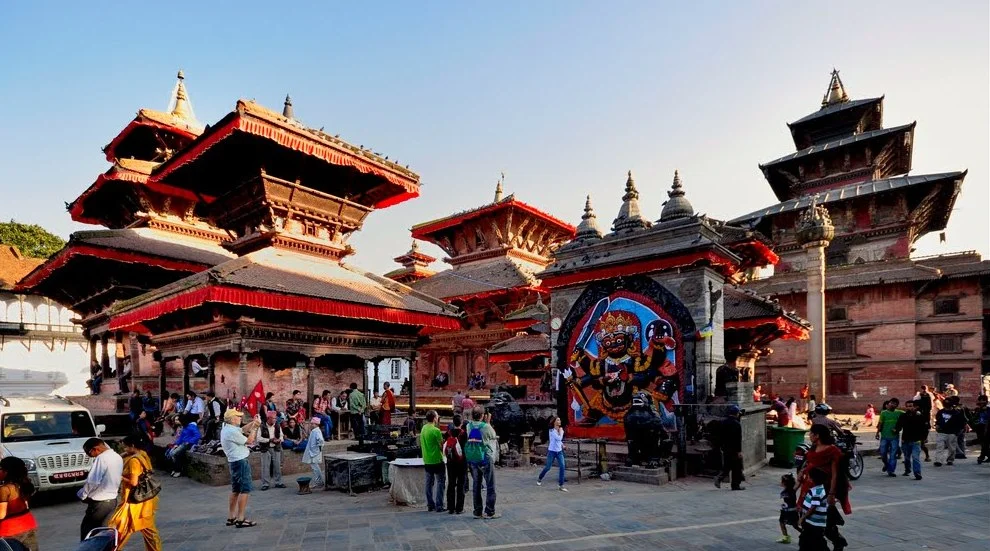
Kathmandu Durbar Square, also known as Hanuman Dhoka Durbar Square, lies at the heart of Nepal’s capital and is one of the seven world heritage sites in the Kathmandu Valley. Its origins date back to the Licchavi period, though most of the structures were built and expanded during the Malla dynasty. The square served as the palace of the Malla and later the Shah kings, making it the center of political and cultural life for centuries. The name comes from the statue of Hanuman, the monkey god, which guards the entrance to the palace complex.
The square is a stunning display of Newar artistry, with intricately carved wooden windows, doors, and struts reflecting centuries of craftsmanship. It is divided into two main sections: the inner palace complex and the outer square, which houses temples, shrines, and courtyards. The Hanuman Dhoka Palace itself was the royal residence until the 19th century and hosted important ceremonies, including coronations. Today, it contains the King Tribhuwan Memorial Museum and the Mahendra Museum.
A unique attraction here is the Kumari Ghar, home to Nepal’s living goddess, the Raj Kumari. Chosen through an ancient selection process, she is considered the human embodiment of the goddess Taleju Bhawani and plays a central role in religious festivals, making rare public appearances throughout the year.
5) Bhaktapur Durbar Square
Bhaktapur Durbar Square is the main plaza in front of the old royal palace of Bhaktapur, about 13 kilometers east of Kathmandu. It is part of the Kathmandu Valley UNESCO World Heritage Sites and a popular tourist destination.
The square includes four connected areas: Durbar Square, Taumadhi Square, Dattatreya Square, and Pottery Square. Its most famous attractions are:
-
55-Window Palace: A 15th-century palace known for its beautifully carved wooden windows.
-
Nyatapola Temple: A five-story pagoda, the tallest in Nepal, built in 1702.
-
Batsala Temple: Famous for its large bronze bell, called “the bell of barking dogs.”
-
Golden Gate: The ornate entrance to the Taleju Temple complex.
-
Pottery Square: A place where traditional pottery is still made.
Bhaktapur Durbar Square was built during the Malla dynasty and showcases the skill of Newar craftsmen. The square reflects both Hindu and Buddhist culture and is still alive with festivals, rituals, and daily life.
6) Patan Durbar Square
Patan Durbar Square, located in the heart of Lalitpur, is one of the three main Durbar Squares in the Kathmandu Valley and a UNESCO World Heritage Site. Built during the Malla dynasty, it is a showcase of Newar architecture and craftsmanship, with over 55 temples and 136 courtyards.
The square is home to famous sites such as Krishna Mandir, Bhimsen Temple, Vishwanath Temple, Taleju Bhawani Temple, and the Golden Temple (Hiranya Varna Mahavihar). Krishna Mandir, made entirely of stone, features carvings depicting scenes from the Mahabharata and Ramayana.
The Patan Museum, originally a palace, houses a rich collection of art and artifacts. The square is still alive with festivals, rituals, artisans, and local markets, reflecting centuries-old traditions. Although many structures were damaged during the 2015 earthquake, restoration efforts have preserved their cultural and historical significance.
7) Changu Narayan Temple
Changu Narayan Temple is one of the oldest Hindu temples in Nepal, located on a hilltop in Bhaktapur, about 7 miles east of Kathmandu. Dedicated to Lord Vishnu, the temple dates back to the 4th century and reflects the architectural style of the Licchhavi dynasty.
The two-story pagoda stands on a high stone plinth and is decorated with intricate carvings of deities, mythical creatures, and symbols. Four entrances, guarded by life-size statues of lions, elephants, and griffins, lead to the temple courtyard, which also houses smaller temples dedicated to Shiva, Krishna, and other deities.
The site contains some of Nepal’s oldest inscriptions, including a 464 CE stone pillar. Surrounded by forests and the small Changu Village, the temple offers panoramic views of the Kathmandu Valley. It is a UNESCO World Heritage Site and remains an important pilgrimage site, showcasing Nepalese craftsmanship, culture, and spiritual heritage.
8) Lumbini
Lumbini, in the Rupandehi District of Nepal, is the birthplace of Siddhartha Gautam, who later became Lord Buddha. According to tradition, Queen Mayadevi gave birth to him here in 563 BCE under a sacred tree. Lumbini is a UNESCO World Heritage Site and an important pilgrimage spot for Buddhists worldwide.
The site includes the Mayadevi Temple marking Buddha’s birth, the Ashoka Pillar, the holy pond Puskarini, and ruins of ancient monasteries. It also has a large monastic zone divided into eastern Theravada and western Mahayana and Vajrayana monasteries, each built in unique styles by different countries.
Pilgrims come daily to meditate, chant, and pay homage. Lumbini symbolizes peace, spiritual learning, and cultural exchange, reflecting Buddha’s teachings of compassion and harmony.
9) Sagarmatha National Park
Sagarmatha National Park is a protected area in eastern Nepal that includes Mount Everest, the world’s highest peak. Established in 1976 and a UNESCO World Heritage Site since 1979, the park covers 1,148 square kilometers in the Solukhumbu district. Its landscape ranges from forested lower slopes to rugged high Himalayas, with peaks like Lhotse, Nuptse, Ama Dablam, and Cho Oyu.
The lower forests are home to birch, pine, fir, rhododendron, and bamboo, providing habitat for wildlife such as snow leopards, red pandas, Himalayan musk deer, Himalayan tahr, and Himalayan monals. The park also holds cultural significance, with Sherpa villages, monasteries, and Buddhist landmarks spread across the region.
Visitors on the Everest Base Camp trek experience both the natural beauty and the rich cultural heritage of this high Himalayan park.
10) Chitwan National Park
Chitwan National Park is Nepal’s first national park, established in 1973 and declared a UNESCO World Heritage Site in 1984. Covering 932 square kilometers in the Terai lowlands, it is home to rich biodiversity, including Bengal tigers, one-horned rhinoceroses, leopards, sloth bears, and Asian elephants.
The park also hosts over 700 species of wildlife, 540 species of birds, and many reptiles, fish, and insects. Its habitats range from dense forests and grasslands to wetlands and riverine areas, supported by the Rapti and Narayani rivers.
The park has historical significance as a former royal hunting ground and is closely associated with the indigenous Tharu community. Chitwan offers visitors a chance to experience Nepal’s wildlife, natural beauty, and cultural heritage in one place.
Tips and Recommendations for Visiting Nepal’s World Heritage Sites
-
Plan Your Route: Group nearby sites together, like Kathmandu, Patan, and Bhaktapur Durbar Squares, to save time and travel efficiently.
-
Respect Local Customs: Many sites are active religious places. Dress modestly and follow temple rules.
-
Hire a Local Guide: Guides provide historical context, stories, and cultural insights you might miss on your own.
-
Timing Matters: Visit popular sites early in the morning or late afternoon to avoid crowds and enjoy better lighting for photos.
-
Stay Hydrated and Prepared: Many sites, especially parks like Sagarmatha or Chitwan, involve walking or hiking—carry water, snacks, and sun protection.
Nepal Royal Treks can help plan your visits and organize smooth itineraries across these cultural and natural sites.