


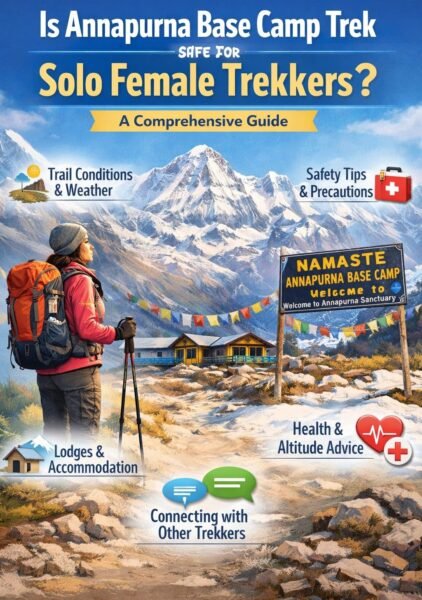
Is Annapurna Base Camp Trek Safe for Solo Female Trekkers?
Imagine that you’re 4,130 meters above the ocean level; also, you notice that you’re in a desert of snow-limited lords of the Himalaya, and you stand next to the massif of the Annapurna, thrust by the peaks of shimmering blue sky. It is the base camp in Annapurna and the camp that calls brave men everywhere in the world. However, this is the question all solo female travelers ask themselves prior to making that booking into this Kathmandu flight: Can I really do this trek on my own?
When you’re considering this classic Himalayan adventure, as a woman, you aren’t the only person who has reservations to make. The safety factor is the most important and the point to consider, as you’re planning to hike in harsh mountainous areas with thousands of long hauls down. The good news? Through due preparation, awareness, and an appropriate mindset, the Annapurna Base Camp trek can not only be safe but also transformative for solo female trekkers.
This was a broadly based guide on all you need to know about solo female trekking in the Annapurna region. We will investigate the actual dangers, street-level precautions, cultural aspects, and tricks of the trade by women who have already completed this trip successfully. Being a highly qualified mountain lover, or even on the verge of taking your first serious mountain trip, this guide will enable you to make a sound decision on whether to do so in the Himalayan range or not.
What makes the Annapurna Base Camp Trek so special?
We shouldn’t speak about safety details yet, but before we do that, the question of what you are getting into needs to be answered. As a mountain lover and enthusiast, and maybe indeed one step down from your first serious mountain trip, this companion will help you make a wise decision about whether it’s the right choice to go to the Himalayan range. It shall carry you thick with terraced rice created, through rhododendron forests as colorful as the rainbow, through a traditional Gurung village where time seems as frozen, and then to high alpine regions where the glaciers revel under the skinny mountain air.
The availability of this journey is combined with the scenic mountain views, which are eye-catching in comparison to other journeys in Nepal. The ABC route is lighter compared to the Everest Base Camp trek, which is relatively easier to complete, and therefore does not require extremely fit trekkers to achieve success. The path is well-trodden, and teahouses are located every few hours along the way; you will always be pretty close to some shelter, hot food, and other travelers.
The trip also normally starts with Nayapul (around 90 minutes from Pokhara) and goes to those villages, including Tikhedhunga, Ghorepani, Tadapani, Chhomrong, and Bamboo, and to Machapuchare Base Camp, and finally to Annapurna Base Camp. The countryside and landscape vary day in and day out; one day it is the subtropical rainforest with birds chirping in the trees, and on the other, it is the valley desolated with barren land featuring the yaks grazing in the barren desolation.
Understanding the Terrain: What Physical Challenges Await?
We should be open about the physical requirements. This trek to Annapurna Base Camp includes a huge growth in altitude—you will ascend to one of the base camps at altitudes of more than 4,000 meters. This involves climbing and descending thousands of paving and stone steps, sweeping rafting suspension bridges, and swaying rocky and even muddy trails of occasionally slippery paths following a rain.
The nature of the landscape alone has a number of safety concerns for solo trekkers. Stone steps might be uneven and worn smooth by thousands of boots, which in any way are unsafe in wet weather. The suspension bridges are tough but can be disheartening to height-shy people, as they tremble as one walks on them, and they have steep falls to the river that are mind-boggling. At some point, especially past 3,000 meters, the trail becomes narrow, and there are sharp drops on one side.
Another complicated thing is the weather. The weather in the Himalayas is well known to be unpredictable. What might have been a bright and sunny morning at one place can turn into an afternoon snowstorm in the higher places or become heavy rain that will make the trails one of the slick mud slides. The leeches cause a real problem in the forested regions during thunderstorm season (June-August), and landslides may occasionally indeed block trails. Nonetheless, and this is what is essential, thousands of trekkers do this route every year with ease, with women among them, alone. It is all about adequate preparation. Get good ankle-supportive trekking shoes with good grip. The pack trekking poles, which form an invaluable balance on the downhill, also relieve the pressure on the knees. Pack clothes to deal with unpredictable weather, such as a jacket and warm-up clothes, when climbing to very high places. Look at the weather before you leave and be liberal with the itinerary where the weather gets unbearable.
The Altitude Factor: Understanding and Preventing Altitude Sickness
This is one of the several things that most first-time Himalayan trekkers do not think about: even though you are very fit, altitude sickness does not discriminate. An ultramarathon athlete may develop acute mountain sickness (AMS), whereas a casual hiker who is casual on the mountain finishes acclimatizing. The important point is to learn about the behavior of your body in thin air and know when action should be taken.
With an altitude of further than 2500 meters, the volume of oxygen input in each breath is low. This takes the time of your body to adjust by increasing the red blood cell count to efficiently transport oxygen. Hurry this, and you may get AMS symptoms; you may experience a headache, feel nausea, feel dizziness, feel fatigue, and lose your appetite. In extreme cases, the altitude sickness may lead to life- hanging scripts similar as pulmonary or cerebral edema.
To female trekkers alone, it is worth being particularly extra-vigilant regarding the risks of altitude, as you will not have a companion to check your symptoms. And this is the golden rule: sleep low, climb high. Acclimatization days must also be included in your schedule, especially before you arrive at Machapuchare Base Camp and Annapurna Base Camp. The safest tours require 8-12 days, which will give your body time to adapt.
Water is your friend at the altitude; you need to be doused by icing that your diurnal water input is 3-4 liters. To help the rate of dehumidification, avoid alcohol, which exacerbates the symptoms of AMS. When you get a headache that isn’t being helped by paracetamol, you begin to feel more queasy or cannot breathe during rest; you need to go down as soon as possible. It’s better not to allow the peak fever to win over your safety—there are always further peaks at another time. It is better not to allow the peak fever to win over your safety—there are always more peaks in another year.
It is possible to recommend taking the medication helping with acclimatization, which is Diamox (acetazolamide). Before visiting a doctor, always consult with your doctor since in most countries it is on prescription. It is prophylactic and used by many experienced trekkers a day before they head to high altitude. There are also some teahouses in higher altitudes with portable altitude chambers (PAC bags) to be used in case of emergency treatment, but you cannot count on them
Cultural Sensitivity: Navigating Local Customs as a Solo Female Traveler
The mountain communities in Nepal are so friendly, yet their cultural norms are fairly well understood and are helpful in guiding positive interactions and improved safety. The Nepali culture, especially in the rural regions, is conservative when it comes to the role of gender and how to act. Nevertheless, locals are also used to Western trekkers and make most allowances concerning cultural aspects.
Since the solo female trekker is a woman all alone, modest dressing portrays respect, and unwanted attention is minimized. It’s a good form of protection to cover shoulders and knees since in the lower townlets, where you’ll be going through domestic areas, it is advisable. As soon as one reaches a major trekking trail, technical clothing (trekking pants, moisture-wicking shirts) is entirely fine, as everyone knows that this is a convenient outfit in the mountains. But unless it happens to be a tank top or a short, leave them to the teahouse rooms and not the common rooms.
The Nepal greeting is called “Namaste” (pronounced “nah-mah-stay”) and is greeted with pressed palms at the level of the chests make entries anywhere. Get to know some material, but first things first: Dhanyabad (thank you), Kati ho? (how much), and Mitho cha (delicious). Nepali efforts, even small-scale, are appreciated by locals, and these little efforts form a rapport that increases the experience, along with the protection of the locals.
Dining areas will be shared between trekkers in teahouses and sometimes with staff and families of the local communities. This is one of the pleasures of the trek because this communal aspect should be observed, although the rules of personal space and privacy should be followed. In Buddhist and Hindu religious locales, there’s always clockwise movement around monuments; this is done by walking in Buddhist or Hindu tabernacles, cloisters, prayer buses, and gravestone chortens. Take off your shoes when you enter temples, and seek permission when taking photos of any person, particularly the monks or those villagers who are elderly.
An artistic note unique to women. A fresh artistic observation is that the period is considered ritually contaminations within Nepali societal customs, and menstruating women in history were banned from visiting some of the religious spots. Although this has evolved and isn’t applied to everyone, especially when visiting active religious places, one should be apprehensive of that. Pragmatically, to take control of the situation during your period on the trail, you need to plan to carry enough supplies; teahouses have only so many things, even waste bags, because there is no uniform standard of toilets.
Personal Safety: Practical Measures for Solo Women
So finally, the most obvious, and the elephant in the room, is the issue of personal security as a woman is travelling alone. The fact is that the safety record of the Annapurna region is significantly good as compared to most of most destinations in the world. Violence against sightseeing is verily uncommon. Touring tourism is the main source of the original frugality, and thus, the communities would be instructed to ensure that the callers are in safe surroundings. With that said, situation awareness and clever precautions are necessary as a female solo trekker. The bad news is that you are very rarely really alone on the ABC trail, particularly in the peak manicure periods (October-November and March-May). You will meet dozens of other trekkers every day, forming their own natural community and network. A large number of lone women get friends throughout the hike, eating together or hiking with them a day or tw,o and then separating.
It is easy on the trek in terms of accommodation safety. Teahouses are family-owned restaurants where people spend their lives living on their premises. Rooms are simple but clean, usually containing simple beds, blankets, and in some cases shared or attached bathrooms. The doors have introductory padlocks or outside latches. Always have a money belt or secure bag that holds your valuables like passport, money, and cards, and/or leave them there even when you are asleep.
The following are some safety measures that have been suggested to lone ladies who decide to do treks. It’s judicious to begin touring beforehand so that you end up at your preferred teahouse before mid-afternoon, so that you avoid taking up the same during the night. Always visit teahouses that are highly rated, and your guidebook and fellow pedestrians may suggest a good teahouse. In co-ed dorm restaurants (usually seen at higher altitudes), find a bed close to other females if possible. Follow your gut instincts; when a circumstance does not sit well, politely make your way out and change teahouses should that be required.
Franklin Delano Roosevelt: In my pack, I carry a particular safety whistle or alarm. Attacks are isolated, but such equipment will confuse any harmful dogs (which at times wander the village) and call for help in case of injury on the trail. When no electricity is available in a teahouse, find a power (banks) to charge your phone since the water electricity is inconsistent in the high altitudes. Save offline maps (Maps.me or Gaia GPS) so that you can travel without a connection to the cellular networks.
As far as the topic of harassment is concerned, there are diverse experiences. The positive experiences that most women report are on the side where the locals are respectful and strongly supportive. Nevertheless, there are still cases of unappreciated attention or attention that is not wanted, constant inquiries about relationship status, awkward gazing, or insensitive remarks. Respond firmly but politely: ‘I’m not interested in talking about that’ or ‘Please respect my privacy.’ In teahouses, position yourself near families or other trekker groups if someone makes you uncomfortable.
Health and Hygiene: Staying Well on the Trail
Hygiene problems in the mountains are one thing, and disease will bring your trip to a halt just as quickly as any other thing would. At the top of the list of complaints made by the trekkers are gastrointestinal problems brought about by the quality of water, unusual foods, or plain exhaustion that suppresses the body’s immune system. You may be on a solo trekking trip; therefore, no one can take care of you when you are sick, thus prevention is always imperative.
Water safety is paramount. Do not drink untreated water that comes out of taps or streams, however clean they may be. The alternatives are to purchase bottled water (costly and a problem for the environment), use water purifying pills (lightweight and useful), or bring a purified water bottle with built-in purification. Others that are often used by trekkers are SteriPEN ultraviolet purifiers or Sawyer squeeze filters. The tea houses serve hot water at a minimal charge—this would be your only chance at cheap, safe water.
Care should be taken with food safety. Eat hot and fresh food instead of food that has been sitting out. The safest bet is dal bhat (lentil soup with rice), as it is made fresh and is served hot. Raw vegetable foods, fruits not peeled, and dairy products should be avoided as you increase in elevation—these have more cases of contamination. A simple rule that is used and followed by many experienced trekkers is “Boil it, cook it, peel it, or forget it.”
They need to include such basics as painkillers (ibuprofen and paracetamol), anti-diarrheal medication (loperamide), rehydration salts, antibiotic ointment, blister bandages, and moleskin, and all medications you regularly take. Other things that many women carry are antimalarials (however, there is not a high risk of malaria in Annapurna), antibiotic courses, in case of respiratory or urinary infection, and antifungal cream because moisture and sweat may lead to problems.
The toilets get worse with increased altitude. Below 3,000 m, lower teahouses may have Western-style toilets, though above that, they are expected to have squat toilets. Incandescence: Bearing in mind that, in Umuofia, men and women share a restroom, bring toilet paper that is biodegradable (or wet wipes in resealable bags) and a headlamp to use at night to visit the restroom. Other women prefer using a pee cloth (a piece of fabric to wipe that has been pre-washed with the specific purpose of urinating) as it is more hygienic, and it does not harm the environment as much as toilet paper. Whichever system you prefer, hand washing will avoid transmission of sickness, which can afflict trekking parties.
Communication and Connectivity: Staying in Touch from the Mountains
Being isolated from the world is one of the fears of many individual travelers. What is favorable is that mobile coverage has attracted significant progress over the past few years across the Annapurna region. Cell towers are available in most large villages, and you can buy an Ncell or Nepal Telecom SIM card in Pokhara or Kathmandu at affordable rates for data packages.
But no, you should not always be connected. Above 3000 meters, there are spotty areas where cellphones will not work, and parts of the country that will leave you with no cell phone signal for 6-12 hours of hiking. It is possible to find many teahouses with WiFi, but the speed is slow and costs 2-5 dollars a day. The further you go uphill, the more costly and ineffective the internet turns out to be. Other trekkers enjoy this digital idyll as an element of the experience; others dislike the disconnection and consider it a stressor.
It is advisable to have a communication procedure with family or friends back home before you begin your journey. Provide your daily agenda with all the places you intend to visit overnight and the approximate time upon arrival at the respective destinations. Avoid high hopes regarding the time frame in which you will be checking in on each other—threatening to call every day is just another way you are planning failure and creating extra stress whenever you run out of coverage. Numerous single females check in after every 4-5 days and send short messages with “I am fine” every 2-3 days on WhatsApp.
There is a need to know how to call an ambulance in case of an emergency. It has emergency contact numbers in Nepal: 100 (police) and 102 (ambulance), but response is a complicated factor during emergencies in remote mountain regions. Tourists can contact the police in Pokhara via +977-061-462761. Your phone contacts must include your embassy or consulate. Some of the trekking regions have Himalayan Rescue Association health posts where consultations on health checks and advice on altitude sickness are free of charge.
The main emergency management with regard to serious medical problems in remote locations is helicopter evacuation. Here, the extensive travel insurance is a necessity. Make sure that you have a policy that specifically deals with high-altitude (more than 4,000 meters) helicopter rescue and adventure pursuits such as trekking. Access your phone policy number and emergency contacts separately, as this will be most critical in an emergency because phone gadgets can fail or be lost and, in situations of emergency, lose battery at the most important time.
Guided Trek vs. Solo: Making the Right Choice for You
The biggest choice a solo female trekker has to make is perhaps whether or not to hire a guide or a porter or to trek entirely alone. No right answer exists out there; it is a matter of experience levels, levels of comfort in uncertainty, budget, and personal tastes. And let us see what each alternative brings.
The experience changes in a number of ways when one hires a guide. Having been professional guides, they are familiar with each part of the trail and with shortcuts, the finest teahouses, and the management of emergencies. They maneuver through permit processes, agree on a place to stay in the high seasons, and also put into perspective the cultural background that adds value to your knowledge. To avoid risks, the guides provide certain medical information regarding altitude sickness, as well as call for rescue should the situation arise. The numerous lone women have claimed that they feel more secure coping with the difficult parts when a guide is around, giving them guidance.
But solo trekking is also not similar to guides. You will always be in the company of companions instead of spending time on contemplation. You are living according to the schedule and pace of someone else. And guides are also very costly overheads—plan to pay 25-35 a day each with their food, lodging, and health cover. Others employ the services of guides during the initial days to gain confidence and then go it alone, although others would employ the services of guides for just the hardest and highest parts.
Porters provide a compromise. They will load your bulky backpack (that gives you the freedom to hike supporting a light daypack), but they will not give as much advice and companionship. Porter costs vary between 15 and 25 a day. This would keep your own independence but would greatly decrease the effect of physical strain, which would be particularly welcome in the case when you fear carrying a heavy load and dealing with the altitude.
Hiking with the sole purpose will provide maximum freedom and independence. You decide how fast or how slow you should go, you stop when you feel like it, you stand longer at a point of view that appeals to you, and you have that deep sense of solitude that most of us find spiritual. The ABC route is well-beaten such that one cannot go astray, provided that one pursues this route contentiously. Trail maps are posted in many teahouses, and other trekkers are likely to be glad to verify that they are on track.
If you employ any support personnel, consider using an agency that is affiliated with the Trekking Agencies Association of Nepal (TAAN). This ensures good insurance and training for guides and porters, along with favorable working conditions. Before committing, ask the potential guides about their experience, their language skills, and their awareness of the emergency procedures. Chemistry is also a concern; you will be spending 8-12 days together, and you want to make sure that you match each other.
Real Women, Real Experiences: Insights from Solo Female Trekkers
There is no better thing than listening to women who have actually done that. Every day, hundreds of solo women hikers share their experiences of Annapurna Base Camp through their blogs, Instagram, and travel forums. The consensus is that … It is quite a possibility and can be quite a changing process, but without difficulty.
These narratives have common themes. It turned out that many women were initially scared to go hiking alone, but the community of the trail was highly supportive. They say that they naturally show up and form temporary trekking relationships with other individual travelers and come up with a loose structure whereby you trek together, but are not required to be with the other person when the paces slow. Such unexpected friendships tend to make the trip interesting.
Women constantly refer to the control of overcoming physical and mental difficulties on their own. Being at Annapurna Base Camp and knowing that you have put yourself there instills confidence that goes way beyond the trekking. It is known by many to be life-changing, though not due to something dramatic, but due to small wonders: overcoming language barriers, persevering through exhaustion, facing the fear of hanging bridges, and showing oneself that they are capable of being in the unknown.
With that said, troubled stories also pay attention to the hardships. Any physical exhaustion becomes a challenge to all those (particularly when climbing the steep area of Chhomrong to the Himalaya Hotel). Evenings which are quiet in teahouses can overwhelm one with loneliness as you see people laughing in groups. Headaches due to altitude put you into a headache-doubting mode. Sad weather days, when confined in primitive rooms, strain the nerves. These are the experiences that are true and legitimate; by admitting them, we do not downplay the accomplishment.
The accident prevention reports are comfortingly few in number. The most frequent hint that women will complain of is altitude sickness (as well as with men) and minor illnesses, and sometimes they simply find themselves too conspicuous because men nearby or other tourists are paying them attention. Severe safety infractions, such as theft, assault, or situations that seem threatening, are strictly rare on this road, partially due to the tight-knit community of this mountain that governs conduct by means of social responsibility.
Essential Gear Checklist for Solo Female Trekkers
Appropriate equipment is the key to the difference between an adventurous experience and a hurting nightmare. In the case of solo trekkers, the reliability of equipment is even more vital because you would be unable to borrow equipment from fellow trekkers in the event of failure. This is what older female solo travelers have found indispensable:
Footwear and Clothing:
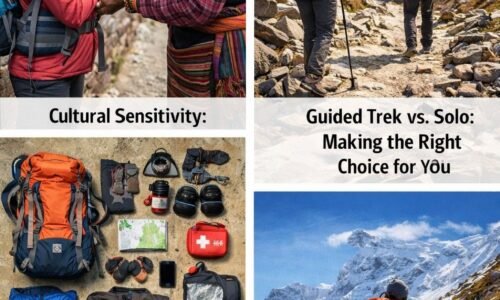
Good hiking boots are broken in before your trip, and they help avoid blisters, which can terminate your adventure. Select ankle-supporting waterproof boots. Base layer moisture-wicking, insulating layers with a hint of fleece or down, and an outer shell and shell made of waterproof and windproof layers. One should bring lightweight trekking pants and warmer ones (for higher elevations). Even a down jacket is necessary at altitude, at night in the ABC, the temperatures commonly fall below zero.
Safety and Navigation:
In Trekking poles, knee strain is lessened, and stability is enhanced. A headlamp that has fresh batteries enables one to move safely around teahouses at night. High- altitude UV protection Sunglasses that are high- altitude UV defensive cover against snow blindness. Download offline maps in your hand, and you might think of a reserve GPS. You should always have a whistle or alarm and a very small first aid kit with you, with the medicine that you usually take.
Hygiene and Comfort:
Carry a light sleeping bag liner in case teahouse blankets are otherwise not so cozy or clean. Bring towels that are fast and thick, dry, a soap that is non-detergent, hand sanitizer, and menstrual supplies that will be sufficient to see you through your trip. A pee cloth or female urination device is used with squat toilets and emergency trail stops. The earplugs help to block snoring roommates, and the eye mask assists in waking up early in the morning in simple rooms.
Power and Communication:
There are several power stations where devices are charged, as the electricity in the teahouses is not very dependable. Carry special power cords and a foreign plug converter, maybe. A solar charger could be considered for use during longer journeys, but it depends on the weather in the mountains.
Should You Trek Annapurna Base Camp Solo as a Woman?
Having exhaustively discussed all the perceptions of solo female safety during the Annapurna Base Camp trek, here is the verdict: It can most certainly be safe–and immensely rewarding to solo women trekkers approaching it with due consideration.
The risks exist, certainly. Altitude sickness is a problem for everyone. The weather can be severe. The physical needs are actual. There is a survival of cultural differences. Nonetheless, these issues can be dealt with by means of proper medication, prospects, and wise prevention. The safety record is there to speak, and thousands of women cross this path every year without any grave incidents.
The infrastructure created around the trekking tourism makes the ABC trek quite appropriate for the solo trekker who is also a woman. The route is well established with frequent teahouses, so you will hardly be more than several hours away from the weather and without a companion. The international trekking community establishes self-support groups. There are great economic reasons for the local communities to preserve safe conditions for tourists. Such a combination alone makes the destinations much safer than in most other adventure travel destinations.
With that being said, not every person can go on a single trek, and that’s no problem. When the thought of the idea makes you shudder and not thrill, seek the services of a guide or a group trek. It is not shameful to come up with a choice that will allow you to enjoy, as opposed to suffering the experience. But when you get the exhilaration of having freedom, when mountain decor fills you, and you’re willing to get ready, fear shouldn’t be the only thing to hold you back. The ladies who have hiked with the ABC alone keep about it as empowering. Not that they were confronted with daily life-and-death situations, but that they had to work their way through the normal life difficulties alone in a new world. They proved themselves that they were able to deal with inconvenience, doubt, and physical stress. They went home different – they were more confident, more able, more conscious of themselves.
The thing is to keep in mind that solo does not refer to doing it alone, as in isolated. You will encounter dozens of other trekkers and make temporary friends, eat with families in teahouses, and feel the enormous generosity of communities living in the mountains. Solo just means that you are left to make your own choices, your own speed, and your own way.
The question is, therefore, whether the Annapurna Base Camp trek is safe for individual female trekkers? With adequate planning, tact, excitement, height awareness, and rational safety precautions- yes. The mountains are calling. It’s time to witness your experience in the Himalayas.
You should trust yourself, train yourself, and take the first step to the beautiful wilderness of Nepal.
The perspective of the base camp with all those giant mountains enclosing it, with the knowledge that you have hauled yourself up there, that will be an indelible memory. And the power and assurance you will bring home? That could simply be the ultimate peak of it all.