


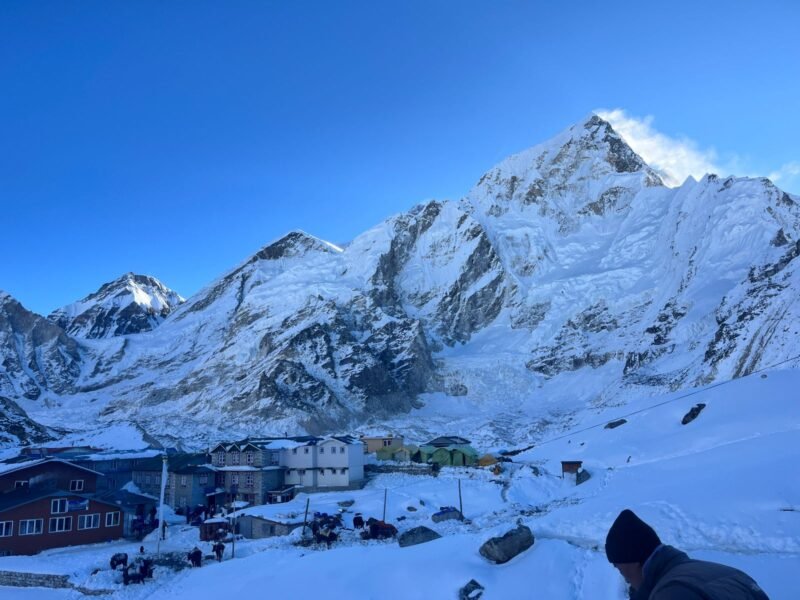
The Highest Mountain Peak in the World Mount Everest
Mount Everest stands as the ultimate symbol of nature’s power and mystery. Towering above the Earth, it marks the highest point on the planet and remains one of the most extraordinary natural landmarks ever discovered. Its snow-covered summit pierces the sky, creating an image that feels almost unreal, yet deeply inspiring.
For decades, Everest has captured the attention of climbers, trekkers, and dreamers from every corner of the world. To some, it represents the ultimate test of physical strength and mental resilience. To others, it is a sacred place filled with cultural meaning, quiet beauty, and an overwhelming sense of humility. Even those who will never attempt the climb are drawn to the stories, risks, and triumphs that surround the mountain.
Reaching an elevation of approximately 8,848.86 meters, or 29,031.7 feet above sea level, Mount Everest is more than just the tallest mountain on Earth. It stands as a powerful reminder of human curiosity, ambition, and the desire to explore what lies beyond the known limits.
What Is the Highest Mountain Peak in the World?
The highest mountain peak in the world is Mount Everest. It holds this title by rising higher above sea level than any other mountain on Earth.
Located in the Himalayas on the border between Nepal and Tibet, Mount Everest reaches an official height of approximately 8,848.86 meters, or 29,031.7 feet. This height was first measured in 1856 at 8,840 meters, later revised to 8,848 meters in 1955, and most recently confirmed in 2020 by the Government of Nepal following a joint survey with China, settling long-standing debates about its exact elevation.
What makes Everest truly remarkable is not just its height, but its presence. The mountain dominates the surrounding landscape and stands as a global symbol of exploration and endurance. Climbers from around the world travel to its base and beyond, drawn by the challenge, history, and prestige associated with reaching its summit.
While many mountains are impressive in their own right, Mount Everest remains unmatched when measured from sea level, earning its place as the highest mountain peak on the planet. Although Mount Everest is the highest mountain above sea level, Hawaii’s Mauna Kea is the tallest mountain when measured from base to peak, standing at approximately 33,500 feet (10,210 meters), even though only 13,796 feet of it rises above sea level.
What Was Mount Everest Called Before It Was Named Everest?
Before the world came to know it as Mount Everest, the mountain went by several different names, each tied to history, culture, and geography.
In 1841, during the Great Trigonometrical Survey of India, the mountain was identified by British surveyors. At the time, it was labeled Peak 15, a simple numerical name used for mapping purposes. Sir George Everest, who served as the Surveyor General of India, did not name the mountain after himself. In fact, he never even saw it in person.
The name Mount Everest was officially adopted in 1865. It was chosen to honor Sir George Everest for his contributions to surveying the Indian subcontinent. From that point on, Everest became the widely accepted name across the Western world and eventually gained global recognition.
However, long before British surveyors arrived, the mountain already held deep cultural significance and established names among local communities.
In Nepal, Mount Everest is known as Sagarmatha, a name rooted in Sanskrit and Nepali tradition. The term translates to “goddess of the sky” or “the head in the great blue sky.” It reflects the mountain’s towering presence and its spiritual importance in Nepali culture.
In Tibet, the mountain is called Qomolangma, which means “holy mother.” This name emphasizes reverence and respect, viewing the mountain as a sacred figure rather than a challenge to be conquered. The name was recorded as early as 1721 in the Kangxi Atlas during the Qing Dynasty. It later appeared in Western maps in the 18th century, sometimes spelled as Chomolungma.
Expeditions
The History of Climbing Mount Everest
Because Everest is the tallest mountain on Earth, it has long captured the attention of explorers and climbers. Whether anyone attempted to reach its summit in ancient times remains unknown. There is some speculation that climbers may have reached the peak as early as 1924, but this has never been confirmed, as none of the individuals on that expedition returned. Over the decades, climbers gradually established routes that are still used today.
The first confirmed ascent of Everest came in 1953. Despite decades of expeditions, the mountain remained extremely challenging. By 1987, only about 200 people had reached the summit.
Everest’s extreme height presents unique dangers. Unlike lower mountains, it can be hit directly by the jet stream, producing winds exceeding 320 km/h (200 mph). Seasonal shifts in the jet stream create brief periods of calmer weather. Climbers also face blizzards, avalanches, and the constant threat of extreme altitude.
The historic 1953 expedition, led by John Hunt, was the ninth British attempt on Everest. Hunt chose two climbing pairs for summit attempts. On 26 May, Tom Bourdillon and Charles Evans came within 100 meters of the top but had to turn back due to oxygen problems. Their work, including route finding and setting oxygen caches, greatly helped the second pair.
Two days later, on 29 May 1953, Edmund Hillary from New Zealand and Tenzing Norgay, a Nepali Sherpa climber, reached the summit at 11:30 am local time via the South Col route. Both climbers acknowledged the climb as a team effort, though Tenzing later revealed that Hillary had stepped onto the summit first. They took photographs and left sweets and a small cross in the snow before beginning their descent.
How Much Does It Cost to Climb Mount Everest?
For anyone dreaming of standing on the roof of the world, the question of cost comes up fast. Climbing Everest is not just about physical stamina; it can hit the wallet hard, too.
To start, climbers must pay for a permit, which is mandatory. From there, the overall expense depends on the kind of expedition. A standard guided climb usually falls between $40,000 and $85,000, while high-end, fully customized trips with extra support, better accommodations, and additional services can easily top $100,000.
The price varies because of several factors. These include the number of Sherpa guides, the quality of food, transportation to base camp, the type of oxygen used, and the standard of living at the camp. On top of that, personal gear and specialized climbing equipment add a significant chunk to the total.
Best Season for Climbing Everest
The ideal time to climb Mount Everest is April to May and again from mid-June to August. The spring months are the most popular because the weather is relatively stable, offering clear skies and milder winds. Summer is technically climbable, but it comes with more unpredictable weather, including rain and clouds, which can make the ascent riskier.
Climbers must also follow the rules set by the Government of Nepal. The government assigns specific climbing windows, and it is not allowed to attempt the summit at just any time. Proper permits and legal documents are required before setting off.
The summit itself is small, roughly the size of a dining room table, covered with a mix of snow, ice, and rock. The rock is mostly Ordovician limestone, a low-grade metamorphic rock, while the snow layer changes from year to year. Below the summit lies the “rainbow valley,” where climbers can still see bodies left in brightly colored winter gear.
Further down, between 8,000 meters and the top, is the infamous death zone, where low oxygen and extreme conditions make every step dangerous.
Best Season for Trekking in the Everest Region
For those interested in trekking rather than climbing, the Everest region offers spectacular experiences. The most popular routes are to Everest Base Camp (5,364 meters) and Kala Patthar (5,545 meters). Kala Patthar is famous for providing one of the best close-up views of Everest’s summit.
The high season for trekking runs from September to mid-December and February to June. During these months, the weather is usually clear and the skies cloudless, giving trekkers stunning views of the mountains. These months are also busier, so expect more fellow trekkers on the trail.
January brings heavy snow and freezing nights, making the trek more difficult, though the mountains look spectacular, fully covered in snow. July and August coincide with Nepal’s rainy season, leading to unpredictable weather, slippery trails, and heavy rainfall.
Choosing the right season can make a huge difference in safety, comfort, and the overall experience of trekking or climbing in the Everest region.
Temperature and Weather on The Highest Mountain Peak in the World, Mount Everest
Mount Everest is known for its extreme and unpredictable weather. The coldest month is January, when temperatures can plummet as low as -76°F (-60°C). Even on milder days, temperatures may only reach around 19°F (-7°C), rarely rising above freezing.
The harsh cold is only part of the danger. Strong winds sweep across the mountain, sometimes carrying snow, ice, and even bits of rock or sand during storms. Sudden weather changes are common, and unexpected blizzards have been known to dump as much as 10 feet (3 meters) of snow.
These conditions make climbing Everest not just physically demanding but also extremely risky. Even minor mistakes or miscalculations in such harsh weather can have serious consequences.
Human Waste & Dead Bodies
On Mount Everest, the extreme conditions make traditional toilets impossible. The frozen ground prevents digging latrines, and the risk of exposure is too high. As a result, climbers often relieve themselves in their tents. It is estimated that around 8,000 kilograms of human waste are left on the mountain each year, creating serious environmental and health concerns. Today, mountaineers are required to carry their waste off the mountain to help protect the fragile ecosystem.
One of the most infamous areas on Everest is Rainbow Valley, located just below the summit along the northeastern ridge and North Col route. The name comes not from natural beauty, but from the brightly colored jackets of climbers who have died there. The valley serves as a stark reminder of the mountain’s danger.
The bodies in Rainbow Valley and elsewhere on Everest reflect the wide range of people who have attempted to reach the top. Most remain where they fell, slowly becoming part of the mountain itself. Each fallen climber tells a story of ambition, courage, and the deadly risks involved in challenging the world’s highest peak.
If you want to make your Everest dream a reality, contact Nepal Royal Treks for expert guidance and support.