

-
 Duration
13 Days
Duration
13 Days
-
 Difficulty
Moderate
Difficulty
Moderate
-
 Max Elevation
4730m
Max Elevation
4730m
-
 Group Size
1 to 10 People Person
Group Size
1 to 10 People Person
-
 Accommodation
Teahouse/Lodge
Accommodation
Teahouse/Lodge
-
 Start/End
Kathmandu Airport/Kathmandu
Start/End
Kathmandu Airport/Kathmandu
-
 Destination
Kanchenjunga Region
Destination
Kanchenjunga Region
-
 Best Season
March-May and Sep-Nov
Best Season
March-May and Sep-Nov

Kanchenjunga South Base Camp Trek is one of the best short remote treks in eastern Nepal for travelers who want a serious mountain journey without going on the full Kanchenjunga Circuit or the North side of the Nepal’s second tallest mountain.
The route heads into the southern side of the Kanchenjunga region and builds slowly from lower village country into a much bigger and harsher Himalayan landscape.
As mentioned earlier, it does not feel like one of Nepal’s crowded mainstream treks. The trail is quieter, the settlements are less in number, and the mountain atmosphere feels stronger with every day you go higher as expected in an higher elevation treks.
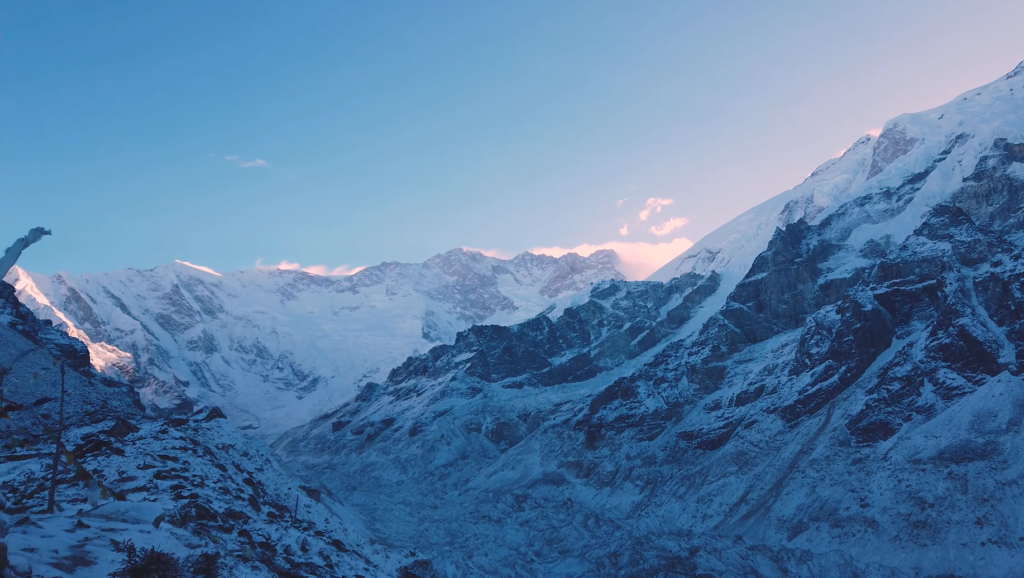
That is big part of what makes this trek special. It gives you a real sense of distance and scale without needing a very long expedition-style itinerary.
Kanchenjunga itself rises to 8,586 meters, making it the third-highest mountain in the world, and this south-side route brings you into one of the most dramatic valleys below it.
One of the biggest rewards of Kanchenjunga South Base Camp Trek is the quality of the mountain scenery once you reach the upper section near Ramche and Oktang.
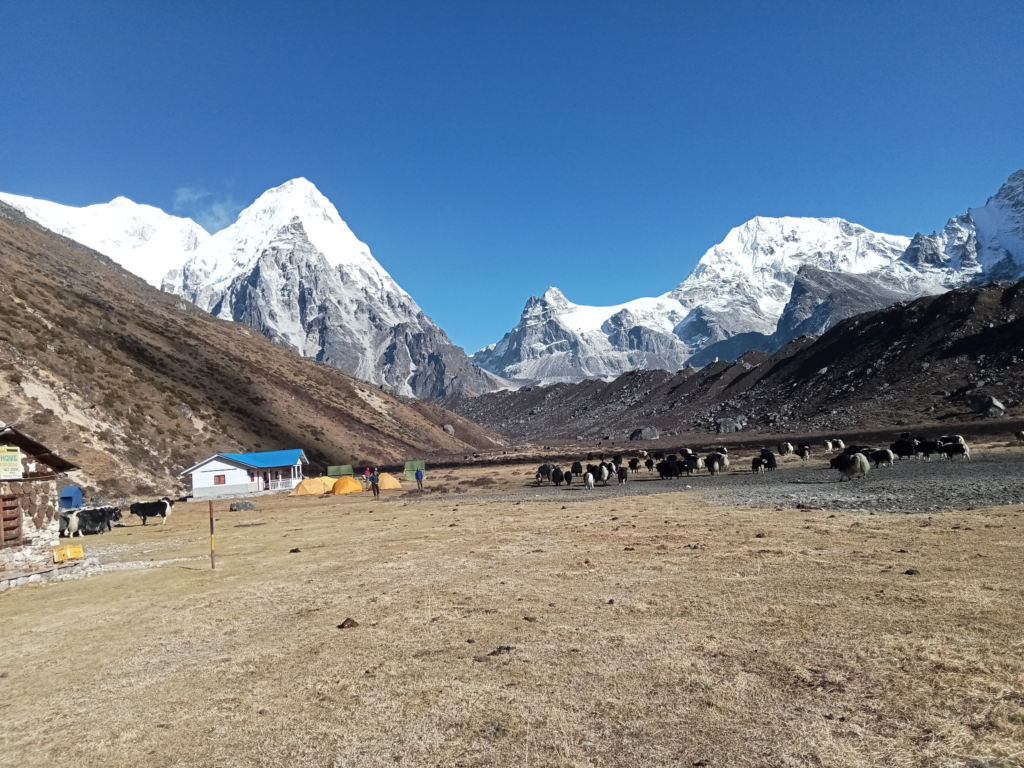
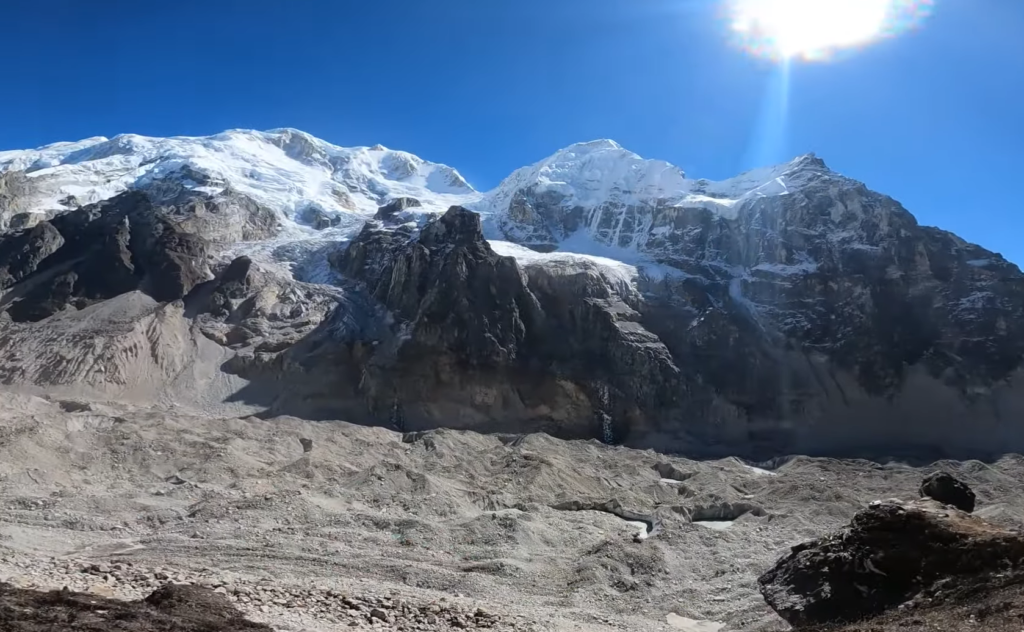
On clear days, the viewpoint area opens to the south face of Kanchenjunga together with the Yalung Glacier, which is one of the defining sights of the entire trek.
Depending on visibility and exact position on the trail, the wider mountain panorama can also include Talung, Jannu or Kumbhakarna, the Kabru range, Rathong, Koktang and Makalu. This is one of the reasons the south-side trek feels so special.
The mountain views do not feel distant or flat. They feel close and deeply connected to the trekkers who want a real mountain experience in one of the less trekked regions.
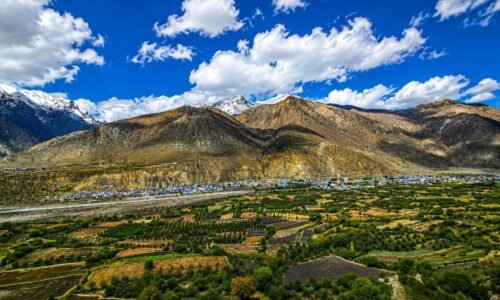
One of the strongest things about this trek is how naturally the landscape changes. The lower days move through eastern hill country where you pass farmland, cardamom fields, village paths, rivers, and forested ridges. The trail feels warm, green, and lived-in at the start.
Then, as you climb through Yamphudin, Tortong, Cheram, and Ramche, the scenery begins to shift.
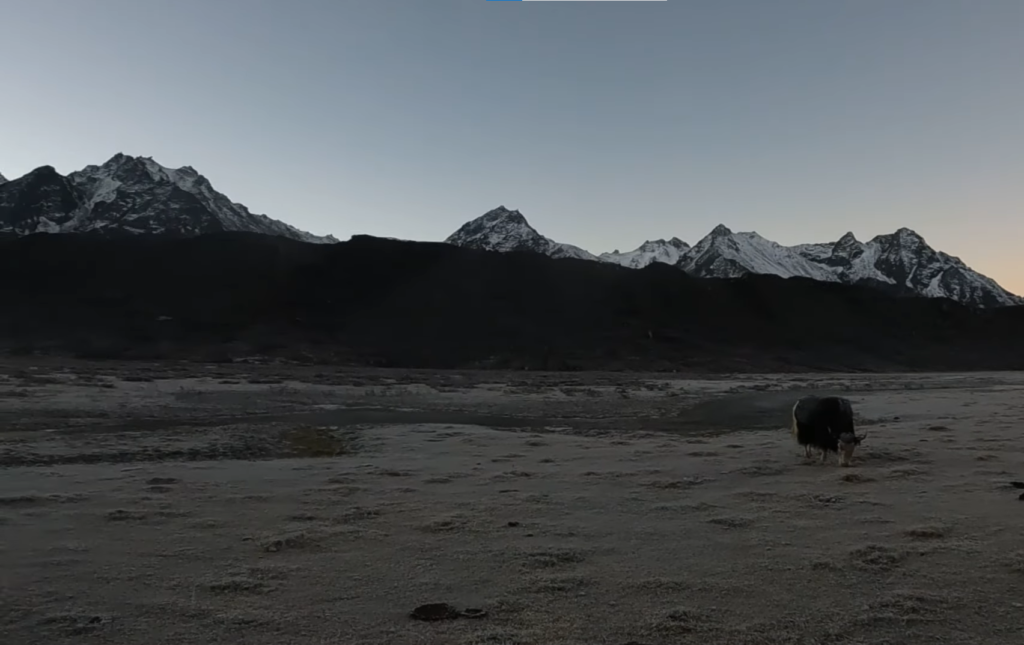
The forests thin out, the valley opens, the air becomes colder, and the route starts to feel much more alpine.
By the time you reach the upper section near Oktang and the South Base Camp side, the whole mood of the trek has changed.
That gradual transformation is one of the most rewarding parts of the journey. You do not jump straight into glacier country. You feel the landscape building toward it.
The upper valley is where the trek becomes unforgettable. From Cheram and Ramche, the route pushes into the Yalung side of Kanchenjunga, where the mountain scenery becomes much bigger and far more dramatic.
This is the section where moraine, glacier-shaped ground, high open slopes, and huge walls of rock and snow begin to dominate the view. It is not just about reaching a marked point and taking a photo.
The real reward is the feeling of standing inside a mountain basin that looks and feels remote in every direction. The trail toward the South Base Camp viewpoint area around Oktang gives the trek its identity.
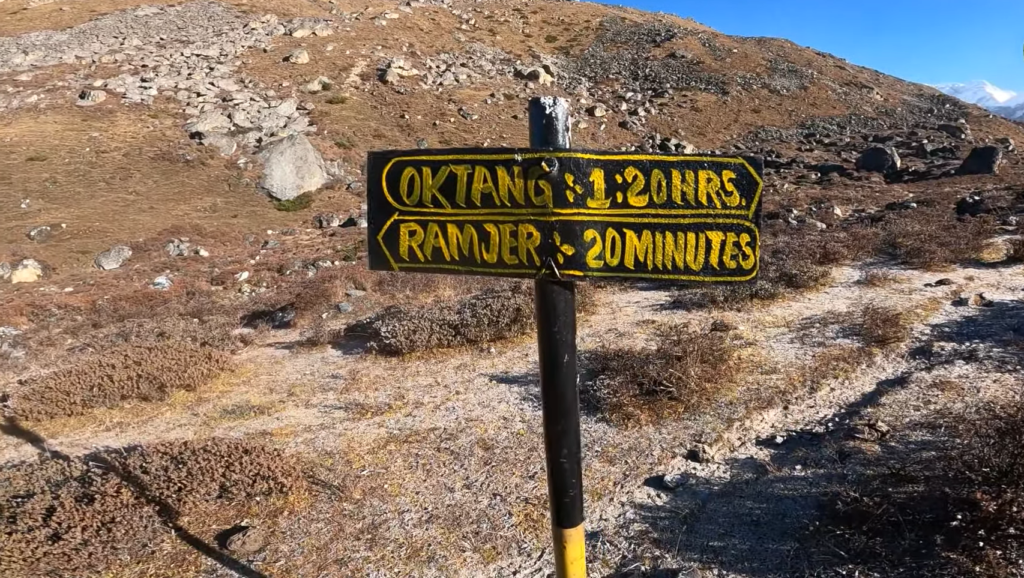
That final approach is what turns the whole route from a beautiful village-to-mountain trek into a proper high-Himalayan experience.
This trek also has a strong cultural side unlike most treks you visit and is much less commercialized.
The lower route passes through settlement areas linked with Limbu and Rai communities, and the village sections give the journey a grounded local feel before the trail grows more remote.
In the lower hills, you see farming land, traditional homes, small trails, and everyday village movement. Higher up, the settlements become fewer, the lodges become simpler, and the trail feels much more like a mountain corridor.
Because of that, the trek never feels one-dimensional or monotonous and gives you a natural feeling whether you are strolling past the farmlands or making yourway through the bushy fores.
The trek gives both local life and big wilderness, and the shift between the two is one of the reasons the route feels so complete.
Another major reason this route stands out is the setting itself. The trek runs inside the Kanchenjunga Conservation Area, one of Nepal’s most important protected mountain regions.
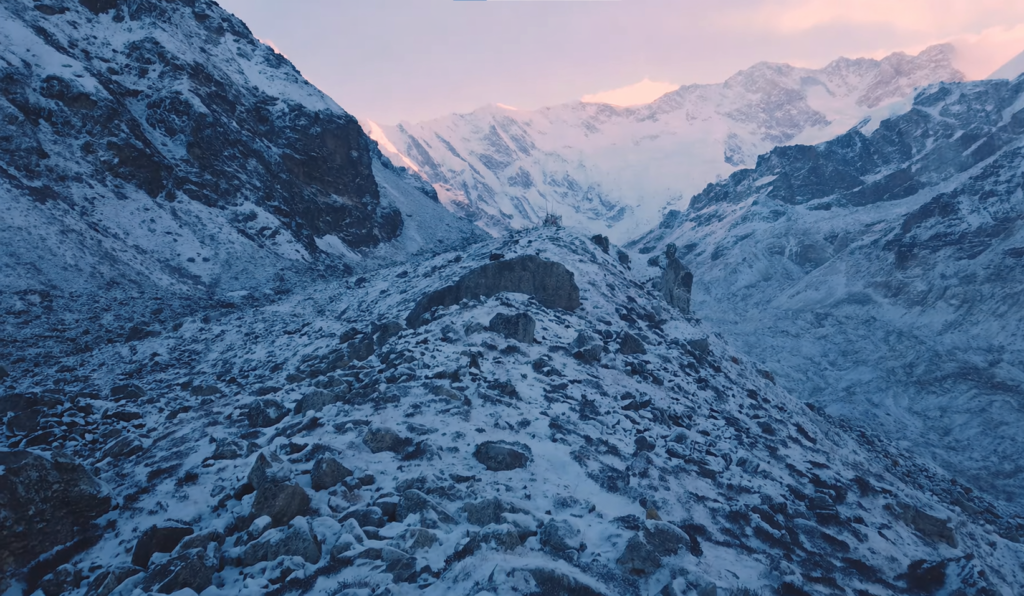
The area covers 2,035 square kilometers and is known for its glaciers, forest zones, alpine terrain, and rich biodiversity.
It is also home to wildlife associated with the eastern Himalayas, including species such as red panda and snow leopard.
Even when wildlife stays hidden, you still feel that you are trekking through a protected mountain ecosystem rather than just walking a scenic trail. The forests, the birdlife, the river valleys, and the high open slopes all add to that sense of depth.
This 13-day version works especially well for travelers who want Kanchenjunga to feel real without stretching the trip too far.
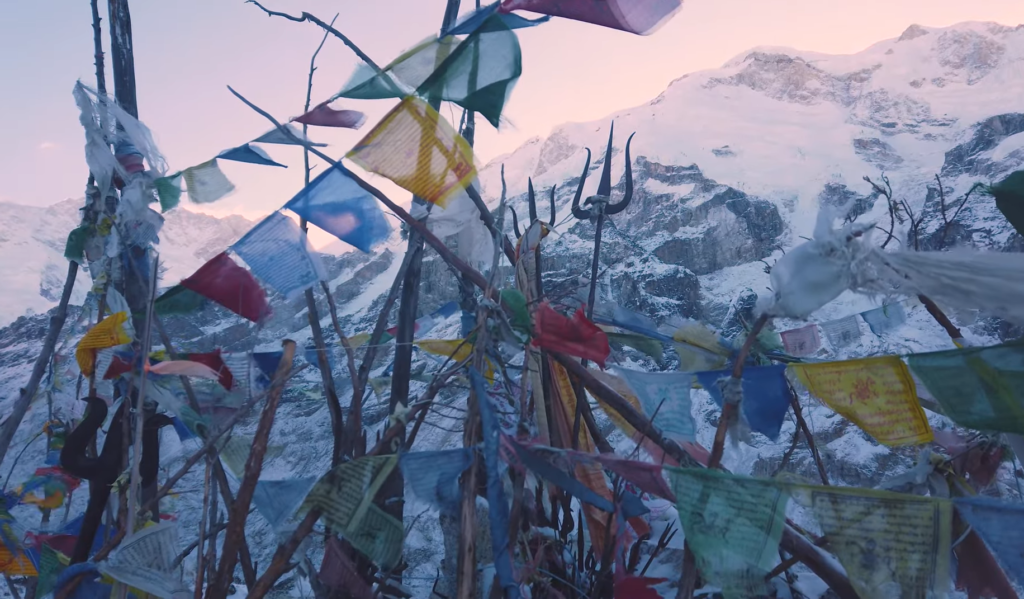
The route uses the southern line through Khebang, Yamphudin, Tortong, Cheram, Ramche, and Oktang, then returns the same side, which keeps the itinerary focused and practical.
That is why this package works so well. It does not try to force the longer full circuit into a short timeframe.
It focuses on the South Base Camp experience and gives enough time for the route to breathe.
The result is a trek that still feels remote, scenic, and demanding, but fits into a shorter holiday window much more comfortably.
In terms of difficulty, this is a moderate to challenging trek rather than an easy introduction to Nepal.
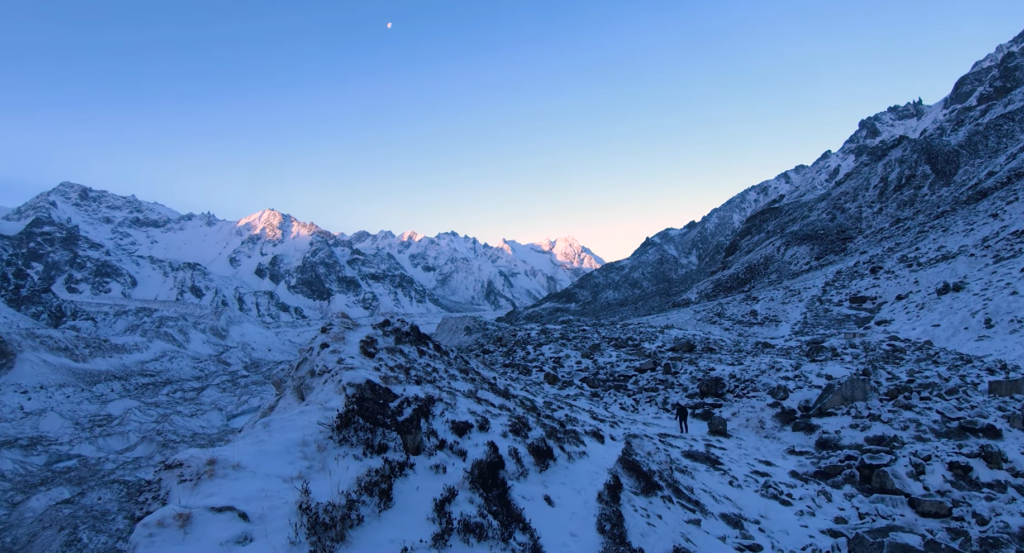
The trail includes long walking days, forest ascents, basic teahouse stays, and a high finish in the upper valley. The challenge is not technical climbing.
It is the combination of altitude, trail length, changing terrain, and the remoteness of the region.
That said, for trekkers who already have decent fitness and want something quieter than Everest or Annapurna, this route is a very strong choice.
The trek gives a real sense of mountain journey without needing the full length of the longer Kanchenjunga itineraries.
Spring and autumn are the strongest seasons for this trek, especially when clear weather opens the views in the upper valley and around the Yalung Glacier basin.
Trip Highlights
- Hike in one of the least crowded major trekking routes in Nepal and experience a side of the Himalayas that still feels remote and silent than the usual commercial circuit.
- Reach the South Base Camp or Oktang viewpoint area at 4730 and enjoy the south face of Kanchenjunga, Nepal's second-highest mountain.
- Enjoy big Himalayan views that includes, Jannu/Kumbhakarna, Talung, Kabru, Rathong, Nyukla Lanchung, and the Yalung Glacier system.
- Trek through the Kanchenjunga Conservation Area, one of Nepal’s most important protected mountain ecosystems.
- Pass through eastern village hill settlements linked to Limbu, Rai, Sherpa, and Gurung communities instead of staying only in heavy tourism filled areas
- Traverse through dense forests, rivers, valleys and glaciers, via Taplejung, Yamphudim, Torongding, Cheram (or Tsarem), Ramche, and the Oktang Base Camp.
- Watch rich biodiversity of the Kanchenjunga region, and get a chance to glance at species such as red panda, blue sheep, snow cock, blood pheasant, and, snow leopard and himalayan black bear if your are lucky
- Start your journey with a shorter and more practical South Base Camp route that gives you the real Kanchenjunga experience in fewer days and comparatively lower elevation.
- Enjoy the landscapes ranging from tea hills, farmlands and river valleys to glacier country, and high mountain walls.
- Stay in teahouses and lodges that keep the journey grounded in local village life and finish with a full sense of progression, because this trek is not only about the summit-side viewpoint but about the entire build from the eastern lowlands into the upper Yalung valley.
Kanchenjunga South Base Camp Trek – 13 Days ~ Itinerary
Day 1
Arrival at Kathmandu Airport - Welcome to Nepal
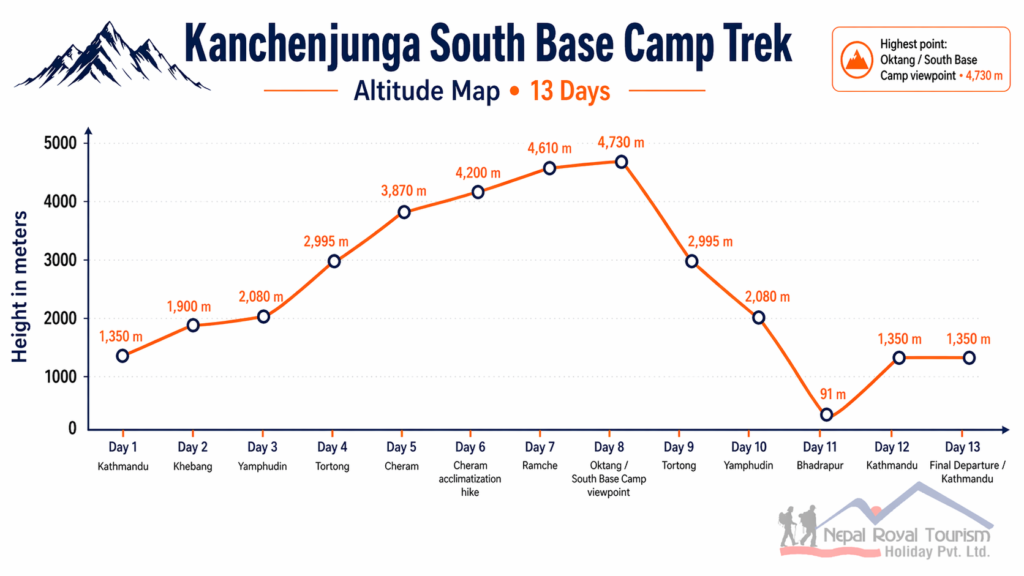
- Max Altitude: 1,350 m
- Meal: Provided for rest of the day depending upon your flight
- Accommodation: Standard Three Star Hotel
Welcome to Nepal’s capital Kathmandu! After arriving in Tribhuvan International Airport one of Nepal Royal Tourism Holiday’s member will transfer to your Hotel in Thamel. You can spend rest of the day leisure or stroll around the UNESCO sites.
Day 2
Fly to Bhadrapur and drive to Khebang
- Max altitude: 2840 m
- Flight Duration: 45-50 minutes
- Travel Duration: 9-10 hours
- Travel Distance: 98 km
- Meal: Breakfast, Lunch and Dinner
- Accommodation: Teahouse in Khebang
You take an early flight from TIA to the lower lands of southeastern Nepal. From there, the road journey takes steadily into the eastern hills towards the southern Kanchenjunga approach. This is a long transfer day, but it is an important one because the landscape changes quickly. By the time you reach Khebang, the trip already feels you have made one step closer to the Himalayas.
Day 3
Trek from Khebang to Yamphudin
- Max altitude: 2080 m
- Trek Duration: 5-6 hours
- Trek Distance: 10-12 km
- Meal: Breakfast, Lunch and Dinner
- Accommodation: Teahouse in Yamphudin
We start today from Khebang. The trail passes through the lower hills, where you will see farmland, mixed forest, small village paths, and river valleys along the way. It is a great first day on the south-side route, giving you a real feel for local life while leaving the road behind and starting the proper trek. As the trail continues toward Yamphudin, the scenery becomes quieter and more beautiful. The route follows the Amji Khola and enters the valley system that takes you to the Kanchenjunga region. Yamphudin is one of the main villages on this side of the trek, where you will get local culture and traditional mountain lifestyle feel.
Day 4
Trek from Yamphudin to Tortong
- Max altitude: 2995 m
- Trek Duration: 6-7 hours
- Trek Distance: 9-10 km
- Meal: Breakfast, Lunch and Dinner
- Accommodation: Teahouse in Tortong
This second trek day, the trail starts to feel more serious as you leave the settlements behind and ascend through the forests and hill section towards the higher valley. As you reach Lasiya or Lamite Bhanjyang, the trail gains height before dropping and rising again. In clear weather, this side of the route can open to views toward Jannu or Kumbhakarna, which adds real excitement to the day. By the time you reach Tortong beside the river, the trek will have clearly moved away from village country and into a quieter mountain area.
Day 5
Trek from Tortong to Cheram
- Max altitude: 3868 m
- Trek Duration: 6-7 hours
- Trek Distance: 9-10 km
- Meal: Breakfast, Lunch and Dinner
- Accommodation: Teahouse in Cheram
This is one of the key climbing days of the trek. The route follows the Simbuwa Khola through rhododendron and pine forest before you open into higher and tough terrain. The day often feels longer than the map suggests because the altitude gain becomes much more noticeable, and the scenery starts changing quickly because first close mountain atmosphere really starts to build. Cheram, also known as Tseram, is an important high stop on the South Base Camp route and marks the point where the trek begins to feel properly remote.
Day 6
Acclimatization at Cheram and hike toward Ramche
- Max altitude: 4200 m
- Trek Duration: 2-4 hours
- Trek Distance: Around 3-5 km depending on the hike
- Meal: Breakfast, Lunch and Dinner
- Accommodation: Teahouse in Cheram
Today is not about rushing higher. It is an important acclimatization day, giving your body time to adjust to the altitude before continuing toward Ramche and the South Base Camp viewpoint. A short hike above Cheram is usually enough to gain some extra elevation, enjoy the upper valley scenery, and then return to sleep lower again. The exact walk can vary depending on weather, pace, and where you stay, but the goal remains the same: climb a little, take in the views, then descend for the night. It is also a great chance to see the surrounding ridges, the widening valley, and the rugged glacier-shaped landscape ahead. Even on a shorter 13-day itinerary, spending an acclimatization day at Cheram makes the higher section of the trek much easier, safer, and more enjoyable.
Day 7
Trek from Cheram to Ramche
- Max altitude: 4610 m
- Trek Duration: 3-4 hours
- Trek Distance: 6-7 km
- Meal: Breakfast, Lunch and Dinner
- Accommodation: Teahouse in Ramche
The walk to Ramche is shorter than earlier days, but it feels much tougher due to growing elevation. You also pass by villages including small area of Lapsang through open high-terrain and broader valley. Ramche is not a major village but an important high trekking stop, and a overnight point stop before the South Base Camp viewpoint zone.
Day 8
Hike to Oktang or Kanchenjunga South Base Camp viewpoint and return to Ramche
- Max altitude: 4730 m
- Trek Duration: 5-6 hours
- Trek Distance: 7-8 km round trip
- Meal: Breakfast, Lunch and Dinner
- Accommodation: Teahouse in Ramche
From Ramche, you move into the upper Yalung Glacier basin toward Oktang, the main South Base Camp viewpoint used on this route. The trail is not extremely technical, but it feels tough . On a clear day, this is where the route gives its biggest reward, the south face of Kanchenjunga, together with views of Yalung Kang, Kabru, Rathong, and in the wider panorama, peaks such as Jannu or Kumbhakarna and Nyukla Lanchung. It is one of the rare viewpoints in Nepal where the mountain does not feel distant. After spending time at the viewpoint, you return to Ramche for the night.
Day 9
Trek from Ramche to Tortong
- Max altitude: 4610 m
- Trek Duration: 6-7 hours
- Trek Distance: 16-17 km
- Meal: Breakfast, Lunch and Dinner
- Accommodation: Teahouse in Tortong
After the high point of the trek, the trail descends from Ramche and retraces the upper valley route back toward Cheram and Tortong. The first section still feels wild and open, with views back toward the Yalung side and the high mountain basin above. As you lose altitude, the route follows the Simbuwa Khola and the landscape changes. This is a long descent day, but it usually feels easier than the climb because you are dropping altitude.
Day 10
Trek from Tortong to Yamphudin
- Max altitude: 2995 m
- Trek Duration: 6-7 hours
- Trek Distance: 10-12 km
- Travel Duration: 150 km
- Meal: Breakfast, Lunch and Dinner
- Accommodation: Teahouse in Yamphudin
Today continues the descent into lower, warmer country. The route changes from trail through forest, river sections, and steeper ups into more lived-in village terrain. This part of the trek can still feel demanding because descents are long and the trail is not always gentle, but the return to Yamphudin brings back farmland, settlement life, and a softer landscape after the harder upper days near Ramche and Oktang.
Day 11
Trek from Yamphudin to Khebang and drive toward Bhadrapur
- Max altitude: 2080 m
- Trek Duration: 5-6 hours
- Trek Distance: 10-12 km
- Travel Duration: 150 km
- Meal: Breakfast, Lunch and Dinner
- Accommodation: Hotel in Bhadrapur
The day begins ith your final trekking day towards Khebang. As expected, this lower section is easier than the mountain days. It gives the trek a softer finish before the long road return begins. After the walk, you continue by vehicle toward the lowlands. The drive gradually leaves the hills behind and drops toward the warmer plains around Bhadrapur, making the contrast with the upper Yalung valley feel even bigger.
Day 12
Fly back to Kathmandu and rest
- Max altitude: 2080 m
- Travel Duration: 45-50 minutes
- Meal: Breakfast, Lunch and Dinner
- Accommodation: Three Start Hotel in Kathmandu
You return to Kathmandu by domestic flight and transfer to your hotel. After several days in a remote trekking region, a quiet day back in the capital feels well earned. This is a good day for recovery, a late meal, light shopping, or simply resting before your international departure. Take this day to stroll around Thamel or buy sovereign for your family and friends.
Day 13
Final Departure
- Meal: Breakfast
Your Kanchenjunga South Base Camp journey ends today. Transfer to the airport for your onward flight and depart Nepal. As your reliable trekking partner, Nepal Royal Tourism Holiday we are thankful for the opportunity to have shared this extraordinary journey during the Kanchenjunga South Base Camp trek.
Kanchenjunga South Base Camp Trek – 13 Days Fixed Departures Dates
Trip Cost Includes/Excludes
Cost Includes
- Airport pick-up and final airport drop in Kathmandu
- Three Star Hotel accommodation in Kathmandu as per the itinerary
- Domestic flights between Kathmandu and Bhadrapur
- All ground transportation during the trek
- Teahouse or lodge accommodation during the trek
- Kanchenjunga trekking permits, TIMS card and conservation area fees
- Breakfast, lunch, and dinner during the trekking section
- Government-registered english speaking trekking guide
- Porters to carry bagpack (one for two trekkers)
- Basic first-aid support carried by the trekking team
- All required local staff arrangements for the trek route
- Trekking completion certificate and complimentary Nepal Royal Tourism Holidays t-shirt
Cost Excludes
- International airfare
- Nepal visa fees
- Personal travel insurance and emergency evacuation coverage
- Personal expenses such as drinks, snacks, hot showers, charging, Wi-Fi, and laundry
- Personal trekking gear and equipment rental unless booked separately
- Tips for guides, porters, and support staff
- Extra hotel nights caused by personal schedule changes or flight disruption
- All other extra cost not mentioned in the inclusions list
Trip Photo/Video Gallery


Route Map for Kanchenjunga South Base Camp Trek – 13 Days
Frequently Asked Questions
Kanchenjunga South Base Camp Trek is a moderate to strenuous trek. The trail is not technical, but it still includes long walking days, steep uphill and downhill sections. The trek is suitable for someone with decent fitness level who has an experience on mountain walks.
The highest point on this route is usually the Oktang viewpoint, at around 4,730 meters. For Ramche overnight stay, the elevation is around 4580 metres.
Most treks in Nepal including this one is teahouse or lodge based. For accommodations you will usually get a twin shared bedroom, Dal Bhat as morning/evening meal and usually noodle soup with egg in the afternoon.
Yes, permits are required. The trek runs inside the Kanchenjunga Conservation Area, and the Kanchenjunga region also uses restricted-area permit arrangements. These are normally arranged before the trek starts.
The upper part of the trek can open to views of Kanchenjunga, Jannu or Kumbhakarna, Kabru, Talung, Rathong, and Koktang. Aprt from those you can also enjoy the views of peaks descriptions also including Siniolchu and Pandim from the wider viewpoint area on clear days.
It can definitely work for a very fit first-time trekker, but it is better for people who already know what multi-day Himalayan trekking feels like. The route is remote, the days can be long, and the upper section is more serious than Nepal’s easier beginner treks.
Most trekking days are around 5 to 7 hours, though some days can be shorter and some can feel longer depending on pace, trail condition, and weather. The upper section near Cheram, Ramche, and Oktang is where the days usually feel more tiring.
Yes, altitude is something to take seriously on this trek. The route rises from low hills to well above 4,500 meters, so proper hydration, and acclimatization is necessary. Even though this is easier than the north-side route, the altitude is still high enough to make people uncomfortable.
The south side is lower and usually less strenuous, with forest trails, village culture, the Yalung Glacier, and close views of Kanchenjunga’s south face. The north side is higher, tougher, and more remote, with rugged alpine terrain, glaciers, and wider mountain views. The south route suits trekkers wanting a shorter and more manageable journey, while the north side is better for those seeking a harder high-altitude trek.
Yes, it can be extended. The south-side route can be turned into a longer Kanchenjunga trek, and some trekkers even opt for a full Kanchenjunga Circuit Trek if they have more time available.
Leave a Review
Kanchenjunga South Base Camp Trek – 13 Days
3 Reviews to Kanchenjunga South Base Camp Trek – 13 Days
You may also like
Menu

John Miller
at 12:39 pm
Adventure Traveler, USA
The Kanchenjunga South Base Camp Trek – 13 Days with Nepal Royal Tourism was outstanding. The views of Mount Kanchenjunga and the peaceful trails made it a truly unforgettable journey.”
Emma Wilson
at 12:36 pm
Trekking Enthusiast
Huge thanks to Nepal Royal Tourism for arranging such a hassle-free and memorable trek. The most amazing part for me was the Kanchenjunga Conservation Area, no doubt about it. Highly recommended team!
David Chen
at 6:55 am
Professional Hiker from Australia
Working with Nepal Royal Tourism was the best choice I made. Expert guides, fantastic assistance, and going up Mount Kanchenjunga were definitely a dream fulfilled!