


Best 6,000m Peaks in Nepal to Climb in 2027: Find the Right Summit, and Plan Your Next Expedition
At some point on a Nepal trek, the trail is no longer quite enough. You have crossed the high passes, stood at base camps, and watched the sunrise over the Himalayan skyline.
The mountains have shown you what they look like from the outside. A 6,000-metre climbing peak in Nepal is the invitation to go further, to swap the trekking trail for a glacier, the walking poles for an ice axe, and the viewpoint for an actual summit.
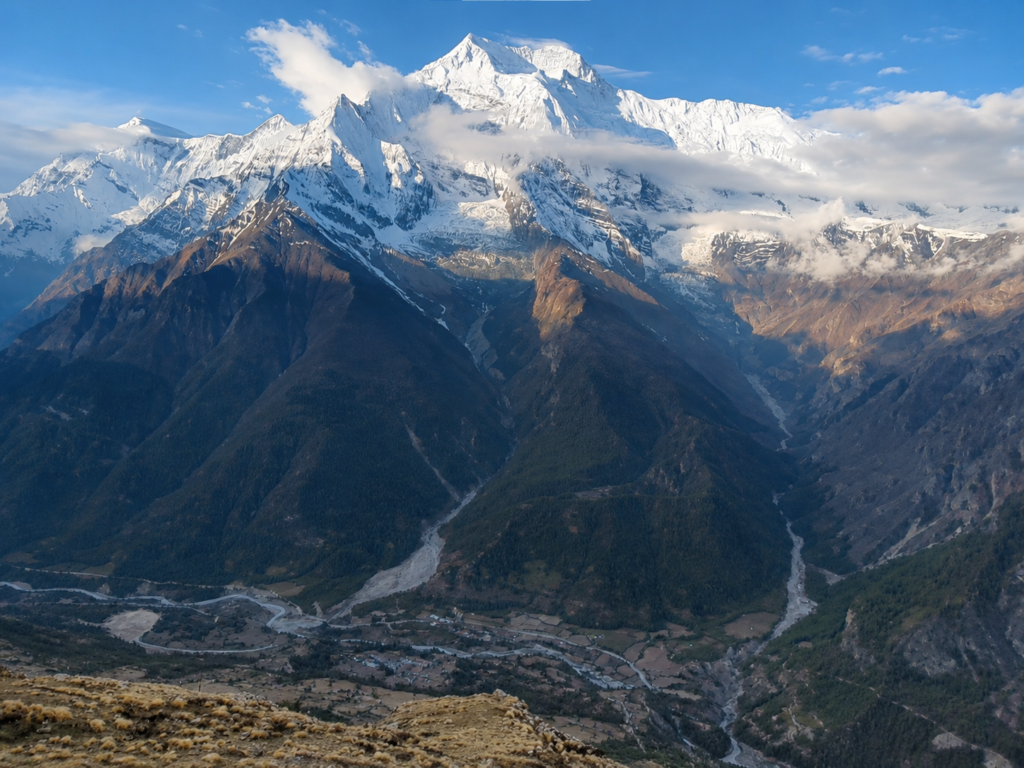
Nepal’s 6,000-metre trekking peaks sit in a specific and valuable category. They are genuine Himalayan climbs with real summit days, real altitude, real glacier travel, and real fixed rope sections.
They are also, with the right preparation and guide, achievable for fit and motivated people who have never technically climbed before.
The gap between trekker and climber in Nepal is smaller than most people think, and larger than most people expect once they are actually on the mountain. Both things are worth knowing before you book.

We have covered every major 6,000-metre trekking peak in Nepal for 2027 with an honest read on what each one actually delivers, not just the height and difficulty rating, but the character of the approach, what the summit day feels like, who belongs on each route, and who should avoid it.
Best 6,000m Peaks at a Glance
| Peak | Height | Region | Difficulty | Trip Duration | Book |
|---|---|---|---|---|---|
| Island Peak | 6,189m | Everest | Moderate | 18 to 20 days | View Trip |
| Mera Peak | 6,476m | Everest | Moderate | 17 to 19 days | View Trip |
| Lobuche East | 6,119m | Everest | Challenging | 18 to 22 days | View Trip |
| Pisang Peak | 6,091m | Annapurna | Moderate | 16 to 18 days | View Trip |
| Chulu East | 6,584m | Annapurna | Challenging | 18 to 22 days | View Trip |
| Chulu West | 6,419m | Annapurna | Challenging | 18 to 22 days | Inquire Now |
| Kyajo Ri | 6,186m | Khumbu | Difficult | 16 to 20 days | Inquire Now |
| Singu Chuli | 6,501m | Annapurna Sanctuary | Very Difficult | 16 to 20 days | Inquire Now |
Island Peak (6,189m)
Island Peak is Nepal’s most popular trekking peak and it holds that position honestly. The approach follows the Everest Base Camp trail through Lukla, Namche Bazaar, Tengboche, and Dingboche before branching south toward Chhukung.
By the time the glacier starts, the body has already spent several days adjusting to altitude in a way that shorter approach routes cannot replicate.
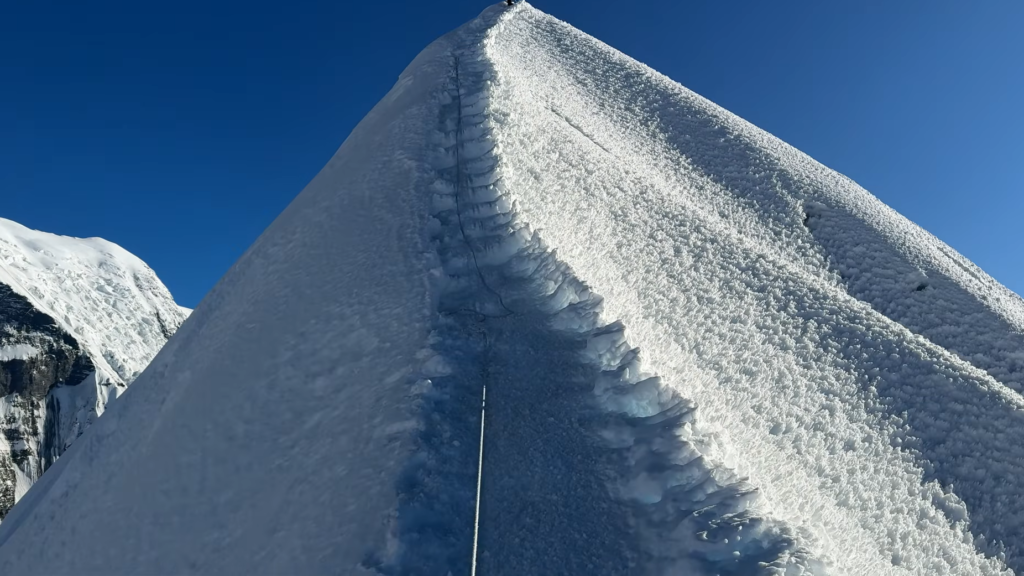
Summit day begins before midnight. The trail from high camp crosses rocky ground before the glacier begins and the crampons go on.
The fixed rope section on the final headwall is steep enough to feel serious and achievable enough to complete with concentration and a good guide.
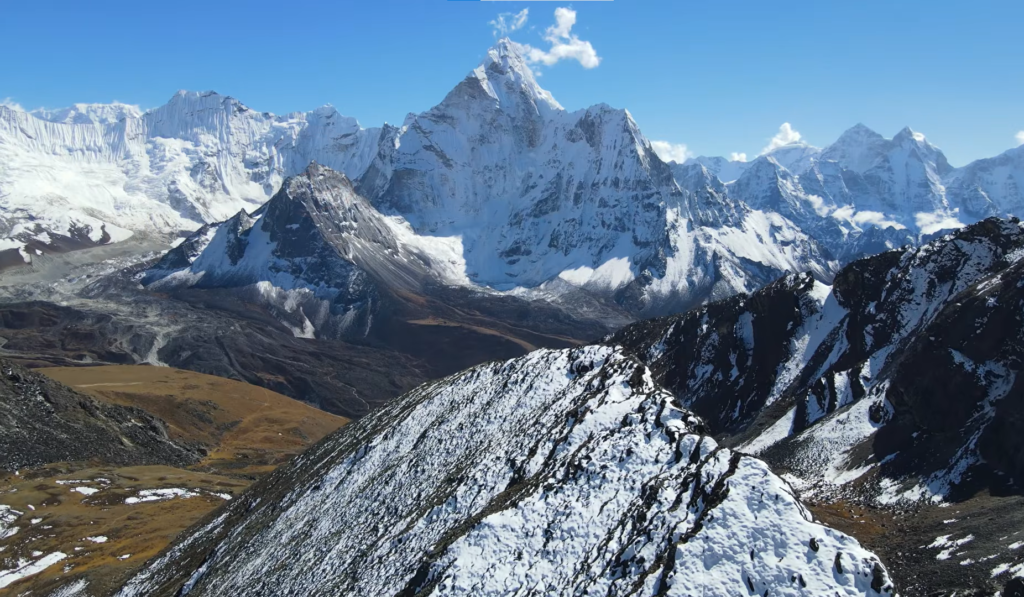
Standing on the summit ridge with Everest, Lhotse, Nuptse, Ama Dablam, Makalu, and Baruntse in every direction is the kind of moment that makes the 4am alarm feel like a very reasonable trade.
| Island Peak | Details |
|---|---|
| Height | 6,189 metres |
| Region | Everest, Khumbu |
| Difficulty | Moderate |
| Technical Sections | Glacier travel and steep fixed rope headwall |
| Summit Views | Everest, Lhotse, Nuptse, Ama Dablam, Makalu, Baruntse |
| Trip Duration | 18 to 20 days from Kathmandu |
| NMA Permit (Spring) | $350 USD per person |
| Best For | First Himalayan climbing experience |
Mera Peak (6,476m)
Mera Peak stands apart from every other trekking peak in Nepal in one specific way. From the summit at 6,476 metres, five of the world’s fourteen highest mountains are visible simultaneously, Everest, Lhotse, Makalu, Cho Oyu, and Kangchenjunga stretched across the horizon together.
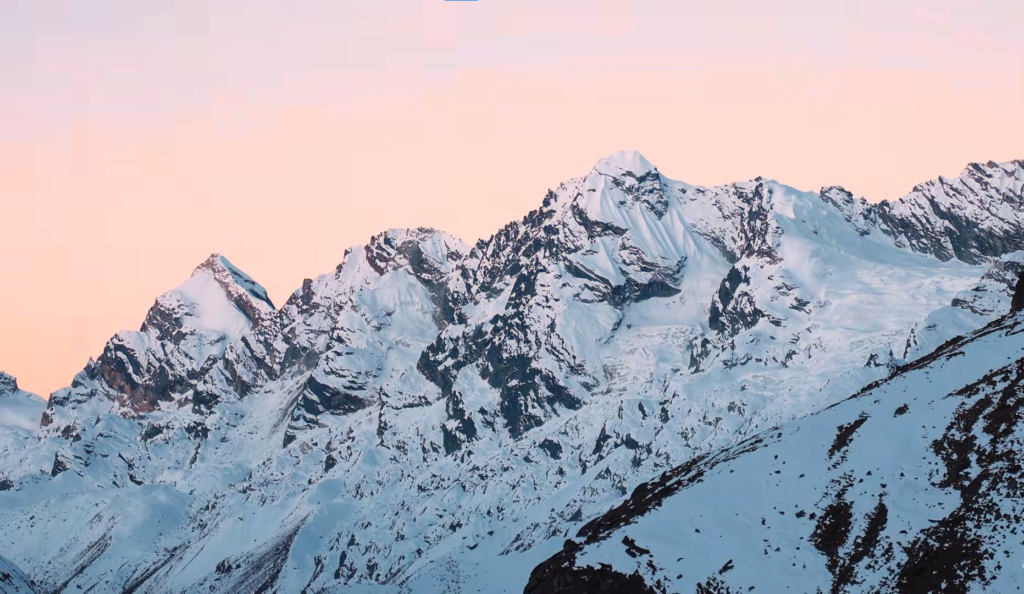
That view is available from no other standard trekking peak in Nepal and it is the reason Mera consistently attracts climbers who have already done the Everest region and want to go higher and see further.
The approach runs through the Hinku Valley, a route noticeably quieter than the main Everest corridors. The technical angle on Mera’s summit slopes is gentler than Island Peak, which makes it more accessible to people new to crampons.
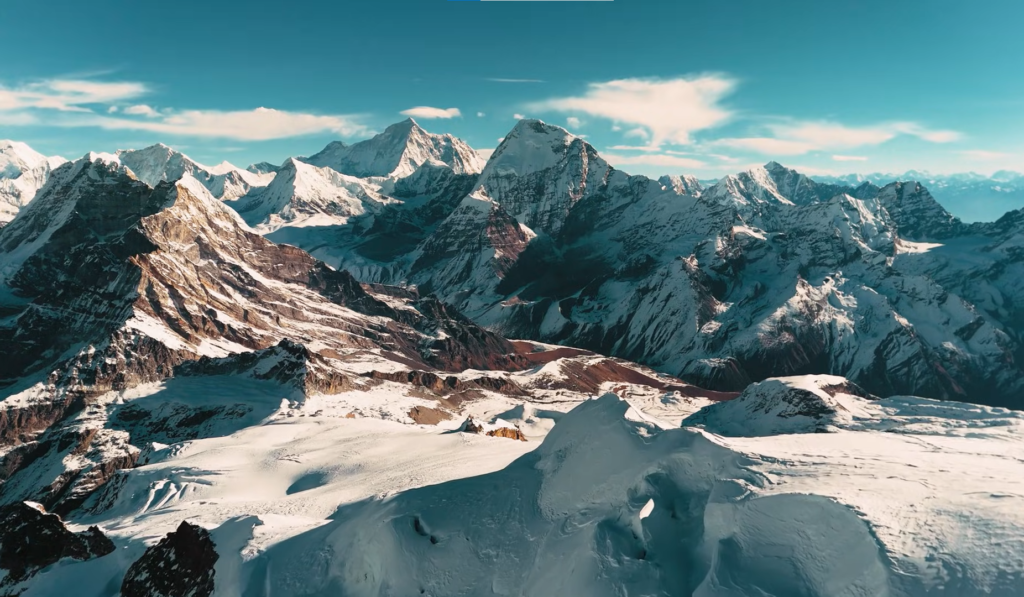
What it demands instead is genuine aerobic capacity and altitude tolerance, summit day is long, the altitude is the highest of any standard trekking peak.
The body needs to have been properly prepared across the approach days rather than arriving tired from rushing the Hinku ascent.
| Mera Peak | Details |
|---|---|
| Height | 6,476 metres, highest standard trekking peak in Nepal |
| Region | Hinku Valley, Everest region |
| Difficulty | Moderate |
| Main Challenge | High altitude and sustained endurance on summit day |
| Summit Views | Everest, Lhotse, Makalu, Cho Oyu, Kangchenjunga — five eight-thousanders |
| Trip Duration | 17 to 19 days from Kathmandu |
| NMA Permit (Spring) | $350 USD per person |
| Best For | Climbers wanting Nepal’s highest trekking peak and the finest summit panorama |
Lobuche East (6,119m)
Most experienced guides in the Khumbu will tell you the same thing about Lobuche East, that it is technically more demanding than Island Peak despite sitting lower at 6,119 metres.
The mountain suits people who have already had a first Himalayan climbing experience and want to find out what the next level actually involves.
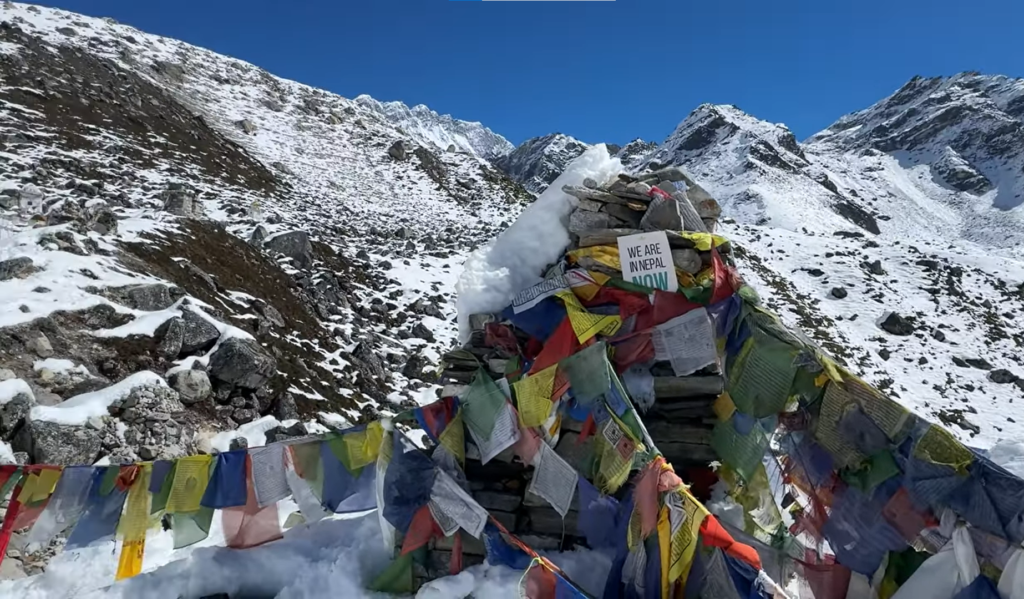
Most itineraries include both Everest Base Camp and Kala Patthar before the summit attempt, giving the body excellent acclimatisation before the technical section begins.
The upper mountain involves steeper snow, more exposed ridge terrain, and conditions that respond more sharply to weather than the lower peaks.
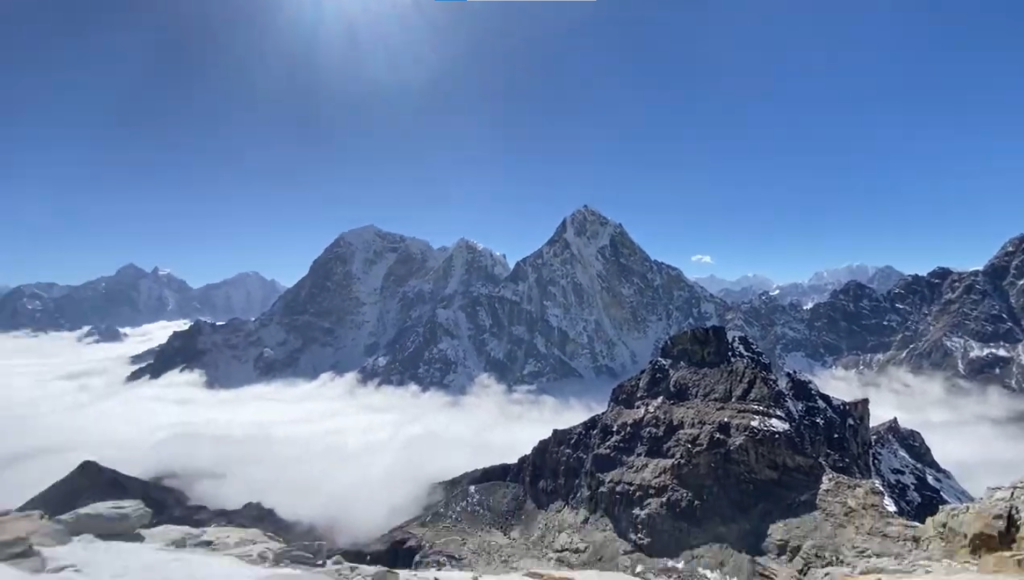
The reward is a summit view that consistently ranks among the finest in the entire Khumbu, Everest, Lhotse, Nuptse, Pumori, Ama Dablam, Cholatse, and Taboche in a complete circle around you.
Climbers who have done both Island Peak and Lobuche East consistently describe the Lobuche East summit position as the stronger of the two.
| Lobuche East | Details |
|---|---|
| Height | 6,119 metres |
| Region | Everest, Khumbu |
| Difficulty | Challenging |
| Technical Sections | Steeper snow slopes, exposed summit ridge, fixed ropes on upper mountain |
| Summit Views | Everest, Lhotse, Nuptse, Pumori, Ama Dablam, Cholatse, Taboche |
| Trip Duration | 18 to 22 days from Kathmandu |
| NMA Permit (Spring) | $350 USD per person |
| Best For | Climbers progressing beyond Island Peak, developing genuine technical skills |
Pisang Peak (6,091m)
Pisang Peak is the Annapurna region’s signature trekking peak and it attracts a specific kind of climber, the one who has already explored the Everest corridor and wants a climbing experience built around a completely different landscape.
The approach through the Marsyangdi valley, past the ancient stone village of Upper Pisang, through the Tibetan Buddhist settlements of the Manang district, delivers a cultural richness that most Khumbu approaches do not carry.
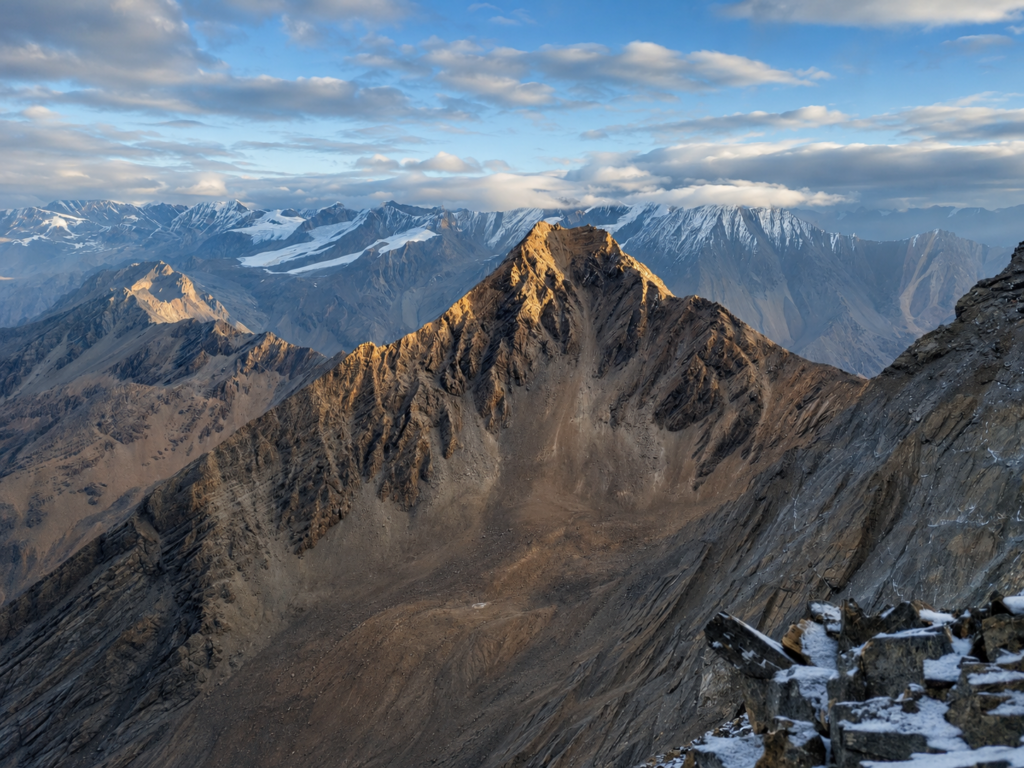
The dry valley, the prayer-flagged ridgelines, and the Annapurna massif above Manang create a visual environment unlike anything in the Everest region.
What separates Pisang Peak itineraries from most other trekking peak packages is the route after the summit. The standard itinerary continues through Manang, crosses Thorong La Pass at 5,416 metres, descends to Muktinath on the Mustang side, and finishes with a scenic flight from Jomsom to Pokhara.
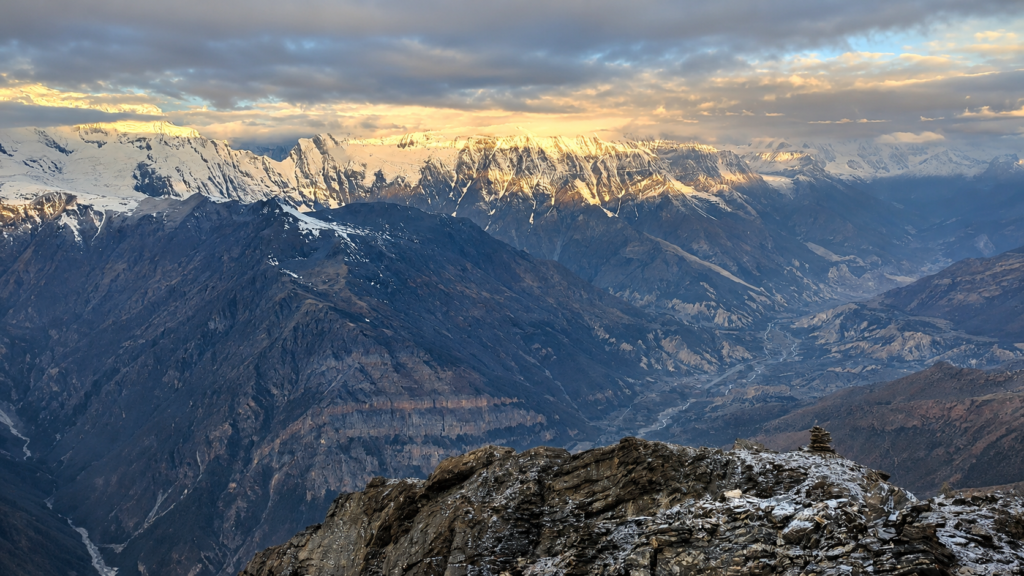
Two distinct high-altitude achievements can be completed into a single journey. The summit panorama covers Annapurna II, III, and IV, Gangapurna, Tilicho Peak, and the full Chulu range.
| Pisang Peak | Details |
|---|---|
| Height | 6,091 metres |
| Region | Annapurna Circuit |
| Difficulty | Moderate |
| Technical Sections | Snow slopes, glacier crossing, fixed rope sections above base camp |
| After Summit | Thorong La Pass 5,416m, Muktinath, Jomsom, scenic flight to Pokhara |
| Summit Views | Annapurna II, III, IV, Gangapurna, Tilicho Peak, Chulu range |
| Trip Duration | 16 to 18 days from Kathmandu |
| NMA Permit (Spring) | $350 USD per person |
| Best For | Annapurna region climbers wanting a complete circuit and summit in one trip |
Chulu East (6,584m)
Chulu East at 6,584 metres is the highest standard trekking peak available in the Annapurna region.
The route leaves the Annapurna Circuit above Manang and climbs into terrain where the expedition character is immediately different, fewer parties, quieter high camps, and sustained altitude above 6,000 metres that demands the body has already been tested somewhere lower before arriving here.
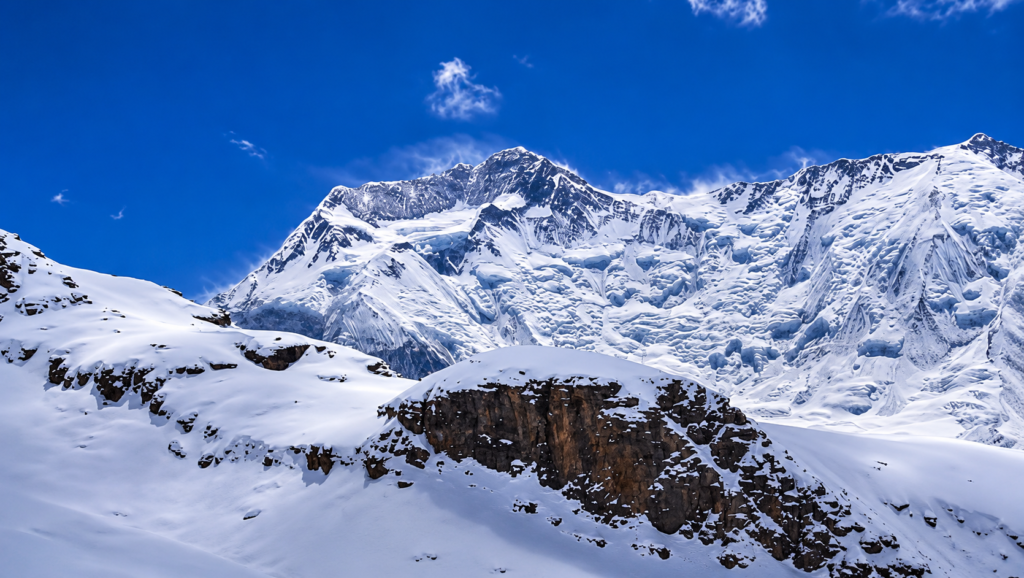
This is a mountain for climbers who have done a trekking peak before and are ready for the next level, not a route for first-timers who want to skip the intermediate step.
Summit day involves glacier travel, fixed rope sections, and conditions that respond to weather more sharply than the moderate Annapurna peaks.
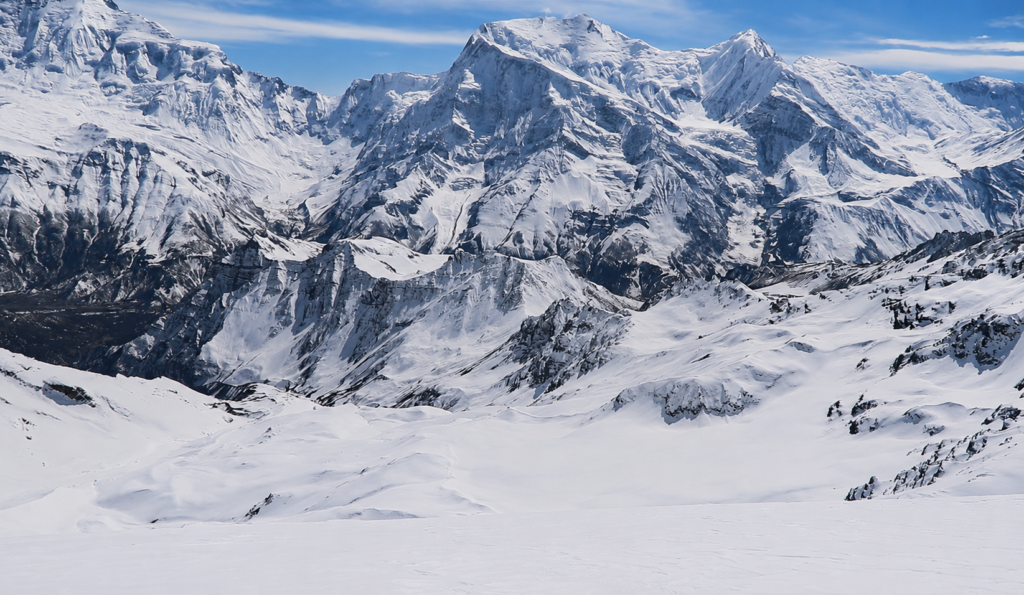
The permit structure also reflects the altitude, Chulu East sits above 6,500 metres, placing it in a slightly higher NMA fee bracket than the other peaks in this guide.
The summit panorama covers Annapurna II, III, and IV, Gangapurna, Tilicho Peak, Dhaulagiri, and Manaslu in a sweep across the finest mountain scenery in central Nepal.
| Chulu East | Details |
|---|---|
| Height | 6,584 metres |
| Region | Annapurna, above Manang |
| Difficulty | Challenging |
| Technical Sections | Glacier travel, fixed ropes, summit sections exposed to weather above 6,000m |
| Summit Views | Annapurna II, III, IV, Gangapurna, Tilicho Peak, Dhaulagiri, Manaslu |
| Trip Duration | 18 to 22 days from Kathmandu |
| NMA Permit (Spring) | $500 USD per person, higher bracket for peaks above 6,500m |
| Best For | Experienced climbers with previous trekking peak summit ready for the next level |
Chulu West (6,419m)
Chulu West shares its Annapurna approach with Chulu East but many experienced climbers who have done both describe it as the more satisfying objective.
The mountain has a stronger expedition character, more complex route finding on the upper sections, and the kind of quiet high camps that only come with a peak that attracts fewer parties than its neighbour.
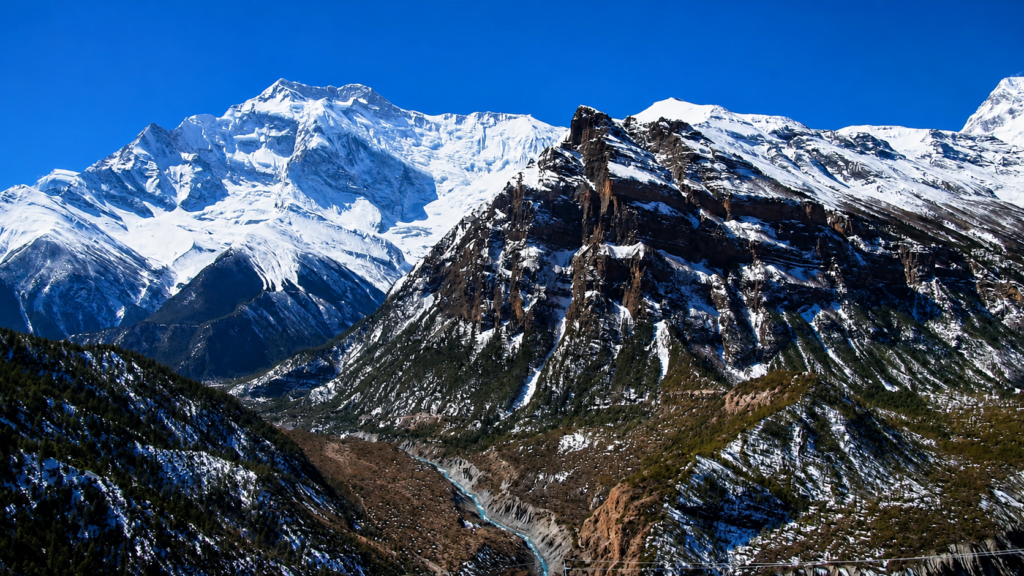
Summit morning crosses snow slopes and glacier before reaching the final ridge, where Annapurna II, III, IV, Gangapurna, Tilicho Peak, Dhaulagiri, and Nilgiri stretch across a continuous Himalayan panorama.
| Chulu West | Details |
|---|---|
| Height | 6,419 metres |
| Region | Annapurna, above Manang |
| Difficulty | Challenging |
| Technical Sections | Snow slopes, glacier, complex route finding on upper mountain |
| Summit Views | Annapurna II, III, IV, Gangapurna, Tilicho Peak, Dhaulagiri, Nilgiri |
| Trip Duration | 18 to 22 days from Kathmandu |
| NMA Permit (Spring) | $350 USD per person |
| Booking | Private custom departures on request |
Kyajo Ri (6,186m)
Kyajo Ri is one of Nepal’s most rewarding technical objectives below 6,500 metres and one of the least known outside specialist climbing circles.
The mountain rises above the Khumbu Valley at 6,186 metres and involves steep snow, mixed terrain, and exposed ridges that place it in a genuinely different category from Island Peak or Lobuche East.
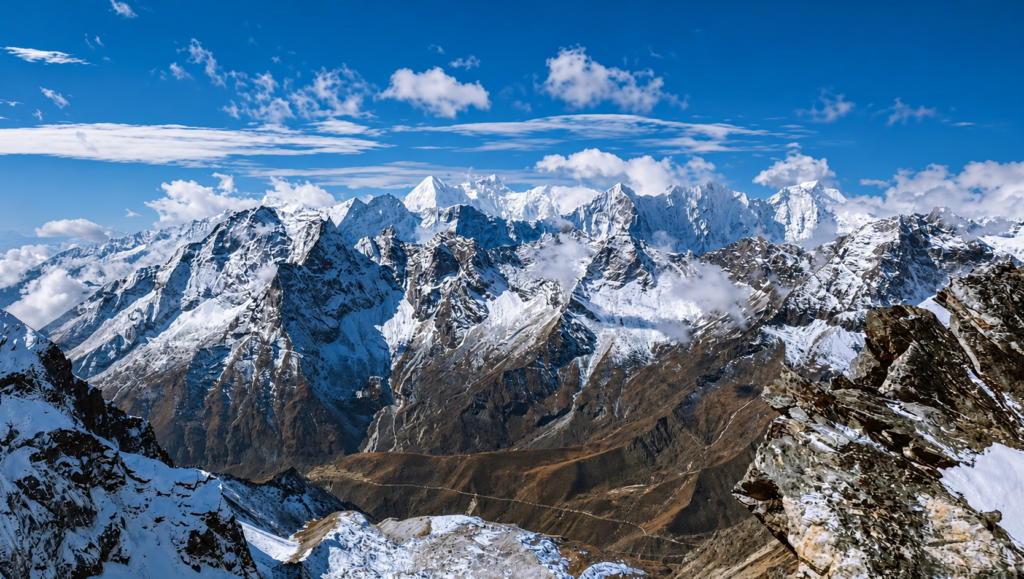
The approach leaves the main Everest trail above Namche Bazaar and the transition from busy trekking route to quiet expedition valley is almost immediate.
From the summit, Everest, Lhotse, Ama Dablam, Cho Oyu, and the full Khumbu skyline stretch across a panorama that very few climbers have seen from this particular position.
| Kyajo Ri | Details |
|---|---|
| Height | 6,186 metres |
| Region | Khumbu, Everest region |
| Difficulty | Difficult |
| Technical Sections | Steep snow, mixed terrain, exposed ridge climbing |
| Summit Views | Everest, Lhotse, Ama Dablam, Cho Oyu, Thamserku, Kangtega |
| Trip Duration | 16 to 20 days from Kathmandu |
| NMA Permit (Spring) | $350 USD per person |
| Booking | Private custom departures on request |
Singu Chuli (6,501m)
Singu Chuli, also called Fluted Peak, sits inside the Annapurna Sanctuary at 6,501 metres and occupies a completely different category from the other peaks in this guide.
While thousands of trekkers walk to Annapurna Base Camp every season and look up at Singu Chuli from the sanctuary floor, only a small number of advanced climbers each year actually attempt the mountain.
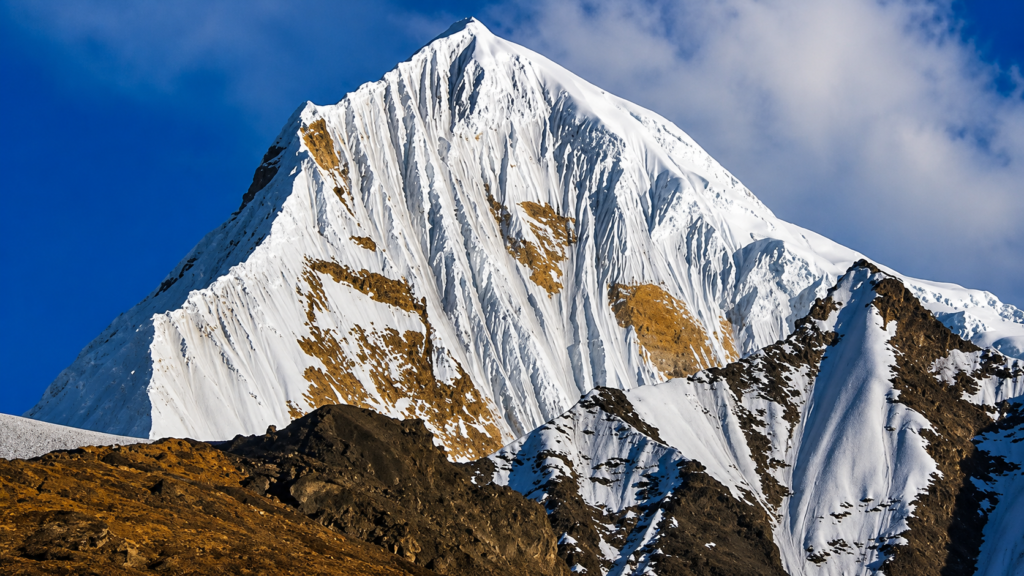
The route involves ice climbing, complex glacier navigation, and objective hazard management that requires a team with genuine alpine experience.
The summit position looks directly into the heart of the Annapurna Massif with Annapurna I, Hiunchuli, Machhapuchhre, Annapurna South, and Gangapurna surrounding the entire skyline.
| Singu Chuli | Details |
|---|---|
| Height | 6,501 metres |
| Region | Annapurna Sanctuary |
| Difficulty | Very Difficult |
| Technical Sections | Ice climbing, complex glacier navigation, objective hazard management |
| Summit Views | Annapurna I, Hiunchuli, Machhapuchhre, Annapurna South, Gangapurna |
| Trip Duration | 16 to 20 days from Kathmandu |
| NMA Permit (Spring) | $500 USD per person, due to altitude over 6,500 m |
| Booking | Private custom departures on request |
Official NMA Permit Costs for 2027
| Peak Name | Elevation | Spring (Mar–May) | Autumn (Sep–Nov) | Winter / Summer (Dec–Feb / Jun–Aug) | Required Regional Permits & Estimated Costs |
|---|---|---|---|---|---|
| Island Peak | 6,189 m | USD 350 | USD 175 | USD 175 | Sagarmatha National Park Permit: NPR 3,000 + 13% VAT (~USD 26) Khumbu Local Tax: NPR 3,000 (~USD 23) |
| Mera Peak | 6,476 m | USD 350 | USD 175 | USD 175 | Makalu Barun National Park Permit: NPR 3,000 + 13% VAT (~USD 26) Khumbu Local Tax: NPR 3,000 (~USD 23) |
| Lobuche East | 6,119 m | USD 350 | USD 175 | USD 175 | Sagarmatha National Park Permit: NPR 3,000 + 13% VAT (~USD 26) Khumbu Local Tax: NPR 3,000 (~USD 23) |
| Pisang Peak | 6,091 m | USD 350 | USD 175 | USD 175 | ACAP Permit: NPR 3,000 (~USD 23) TIMS Card: NPR 1,000 (~USD 8) |
| Kyajo Ri | 6,186 m | USD 350 | USD 175 | USD 175 | Sagarmatha National Park Permit: NPR 3,000 + 13% VAT (~USD 26) Khumbu Local Tax: NPR 3,000 (~USD 23) |
| Chulu West | 6,419 m | USD 350 | USD 175 | USD 175 | ACAP Permit: NPR 3,000 (~USD 23) TIMS Card: NPR 1,000 (~USD 8) |
| Chulu East | 6,584 m | USD 500 | USD 250 | USD 200 | ACAP Permit: NPR 3,000 (~USD 23) TIMS Card: NPR 1,000 (~USD 8) |
| Singu Chuli | 6,501 m | USD 500 | USD 250 | USD 200 | ACAP Permit: NPR 3,000 (~USD 23) TIMS Card: NPR 1,000 (~USD 8) |
All permits must be arranged through a registered Nepali trekking agency, individual climbers cannot purchase NMA permits directly. Since 2023 a licensed guide is legally mandatory for all climbing trips in Nepal. Climbers must also pay Refundable Garbage Deposit of USD 500 for every peak.
Which Peak Should You Choose?
| If You Are… | Choose This Peak | Key Reason |
|---|---|---|
| A first-time Himalayan climber in the Everest region | Island Peak | Classic entry point, excellent acclimatisation, EBC approach included |
| Chasing Nepal’s highest trekking peak and widest panorama | Mera Peak | Five eight-thousanders visible, gentler technical angle, quieter Hinku Valley |
| Ready to progress technically after Island Peak | Lobuche East | Steeper terrain, more exposed ridge, finest summit view in Khumbu |
| Wanting Annapurna culture plus summit plus circuit | Pisang Peak | Summit plus Thorong La, Tibetan Buddhist approach, complete itinerary |
| An experienced climber wanting the highest standard trekking peak | Chulu East | 6,584m, demanding, expedition atmosphere, exceptional Annapurna panorama |
| Wanting a quieter Annapurna alternative to Chulu East | Chulu West | More complex route finding, fewer parties, stronger expedition feel |
| A technical climber wanting an off-radar Khumbu objective | Kyajo Ri | Mixed terrain, quiet approach, exceptional summit position above Khumbu |
| An advanced alpine climber seeking the Annapurna Sanctuary | Singu Chuli | Ice climbing, glacier navigation, summit inside the Annapurna amphitheatre |
Best Season for Nepal Peak Climbing in 2027
| Season | Months | Conditions | Climbing Verdict |
|---|---|---|---|
| Spring | March to May | Warmer, stable weather windows, busy on popular peaks | Strongly recommended — best snow and highest summit success rates |
| Autumn | September to November | Clearest skies of year, colder at altitude, superb visibility | Strongly recommended — finest summit panoramas, dry firm conditions |
| Winter | December to February | Very cold, lower permit costs, minimal crowds | Possible for experienced teams, not recommended for higher or technical peaks |
| Monsoon | June to September | Heavy rain, poor snow conditions, elevated avalanche risk | Not recommended for any peak climbing |
Getting Started Below 6,000m (Gateway Peaks for Beginners)
If the peaks above feel like too large a commitment for a first climbing trip, Nepal also has two excellent sub-6,000-metre options that give a genuine taste of glacier travel and crampon technique without the full altitude challenge of the 6,000-metre category.
These are not the same experience as a 6,000-metre peak but they are the right starting point for complete beginners who want to know what Himalayan climbing actually feels like before committing to a higher objective.
| Gateway Peak | Height | Region | Best Step Up To | Book |
|---|---|---|---|---|
| Yala Peak | 5,732m | Langtang | Island Peak or Mera Peak | View Trip |
| Paldor Peak | 5,896m | Ganesh Himal | Pisang Peak or Chulu East | View Trip |
Plan Your Nepal Peak Climbing Trip in 2027
Every climber starts somewhere. Whether your goal is a first glacier walk or standing above 6,400 metres on Mera Peak, choosing the right mountain makes the entire experience more enjoyable and much safer. If you are unsure which peak matches your current experience, fitness, or available time, our climbing team is happy to help you decide, honestly, without pushing you toward something that does not fit where you are right now.
Ask Nepal Royal Tourism Holidays View All Climbing Trips